
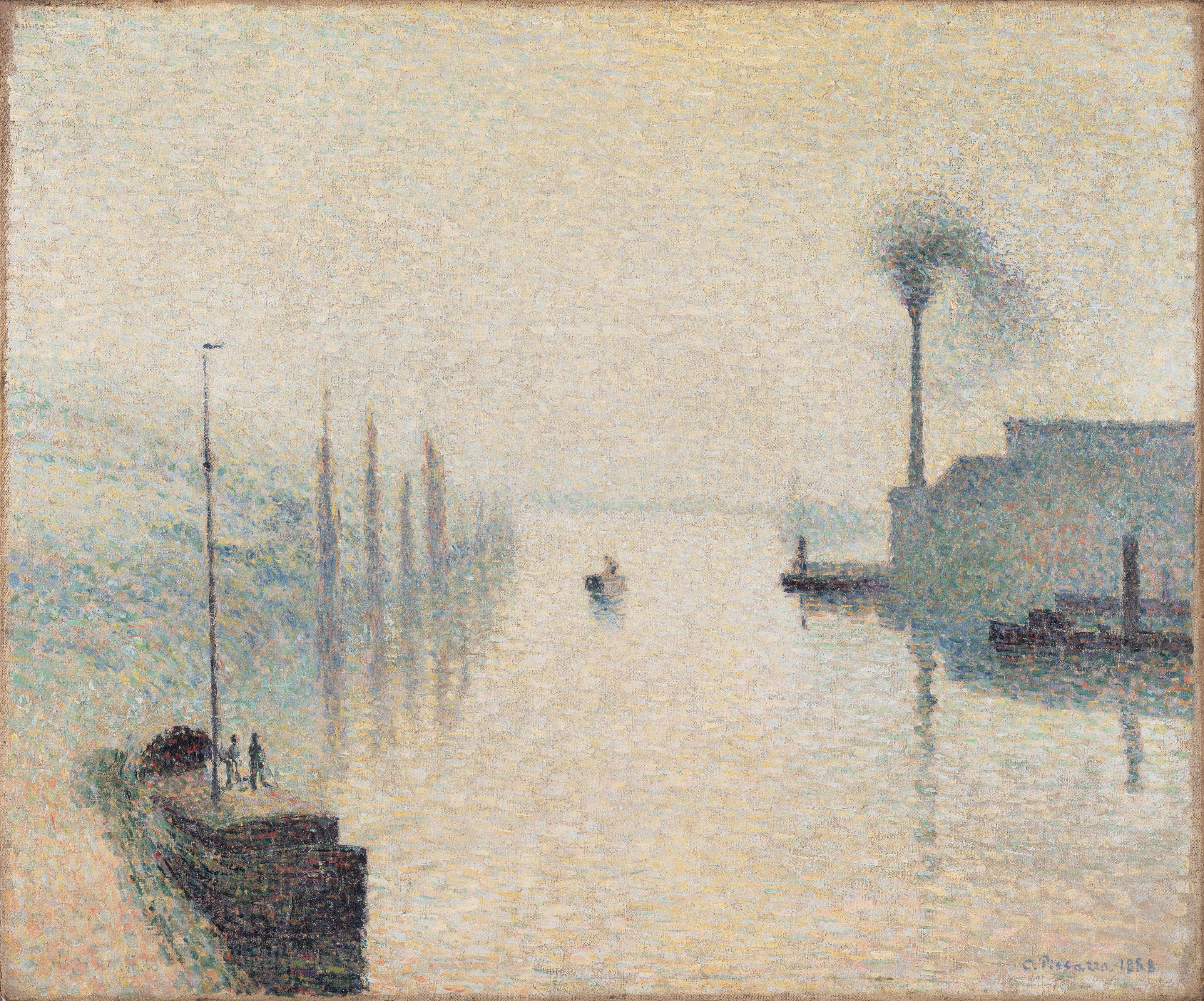
on fog
weather and home

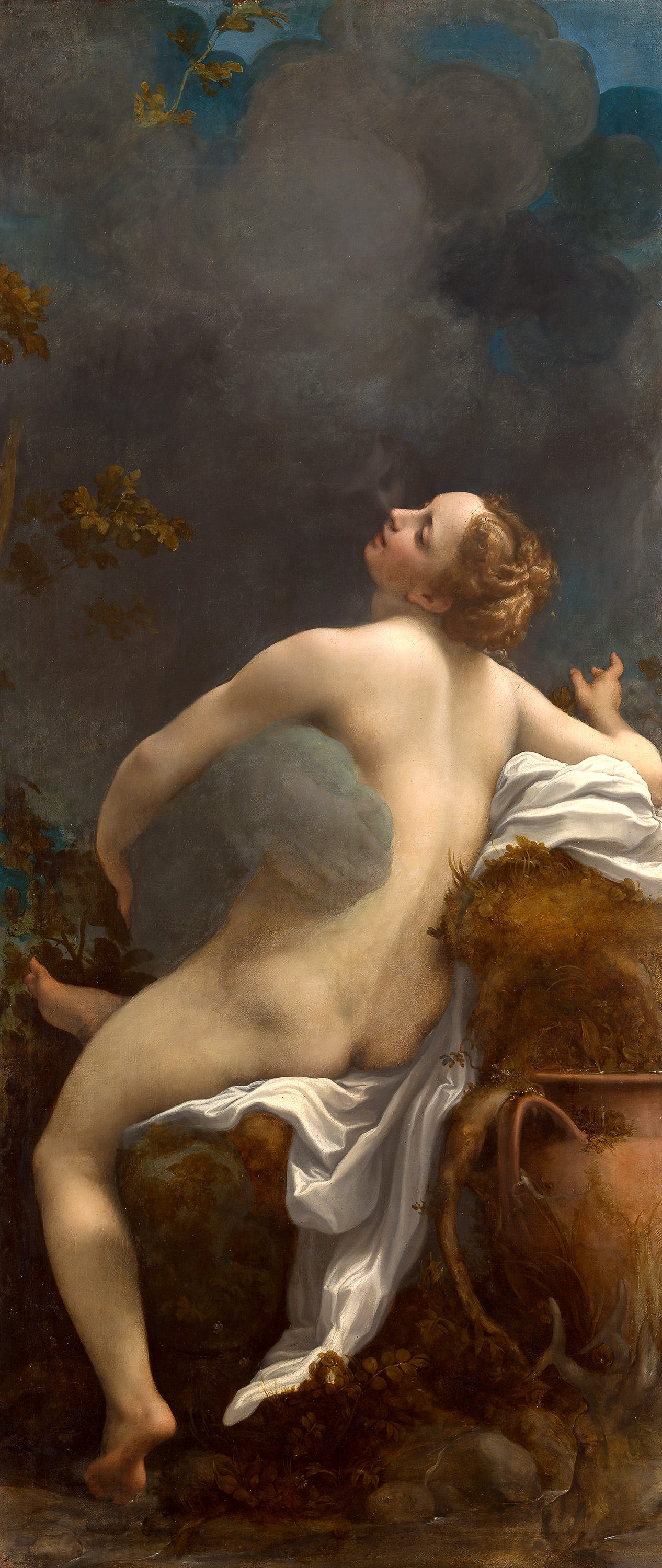
The learning we received only tended to obscure our vision. From the day we went to school we learned nothing; on the contrary, we were made obtuse, we were wrapped in a fog of words and abstractions.
—Henry Miller, Tropic of Capricorn
For d’ye see, rainbows do not visit the clear air; they only irradiate vapor. And so, through all the thick mists of the dim doubts in my mind, divine intuitions now and then shoot, enkindling my fog with a heavenly ray.
—Herman Melville, Moby-Dick
It was a time of quiet and of waiting. The air was cold and tender. A light wind blew up from the southwest so that the farmers were mildly hopeful of a good rain before long; but fog and rain did not go together.
—John Steinbeck, “The Chrysanthemums”
There is something to be said for not knowing exactly where we’re going. We are so often wrong to believe we know in the first place. It may startle us, when the realization of our illusory control finally dawns. Like driving down a road we’ve taken any number of nights before, calmly making each rote turn, secure in our vehicle with high beams illuminated and seatbelts fastened, and a sudden deer springs from pitch black margins across our path. There’s no telling what else lies in store. Our lives are all circumscribed by this obscurity—from the moment the amnion curtain opens to the closing of the coffin—and our world too, drifting as it does on a benign spur of hazy spiraling galaxy within the inconceivable vastness of a dimly discerned universe. Yet we keep trying to stake out our own plot here, to produce something that lasts or cut a new trail through the underbrush, and we want clarity and vantage to aid us in this. But what looks clear as day from afar can turn out on arrival to be mirage. And there are unsung advantages to lower visibility. When we find ourselves shrouded in opaque fog we’re forced to slow down and feel along our way. Other senses heighten when visual perception is impaired, bringing intimate details and deeper insight to our attention. Perspective closes in on the immediate, what is near enough to touch us. If dangers hide nearby, we are cloaked in the same brume, protected as if by spell or potion. Surprising forms may loom up in front of us, and evaporate as quickly into vague mist. With practice we begin to embrace the shadows and notice the play of gleams through clouds. The notebook, with its nebulous traces and erasures and condensations of thought and language, provides the ideal conditions for our personal weather.
Three forms of nature expand and enlarge our soul, make it extend and sail through the infinite: the unsettled ocean of the air, with its festival of lights, its vapor, its half-light and its moving phantasmagoria of rapidly fading and capricious creations; the fixed ocean of land, with its undulating surface that can be observed from the top of tall mountains, upheavals that bear witness to its ancient mobility, the sublimity of its peaks and their eternal ice; and finally, the ocean of water. Less mobile than the first, less fixed than the second, it obeys celestial movements in its well-regulated swaying.
—Jules Michelet, The Sea (trans. Katia Sainson)
I grew up in fog. The Monterey Peninsula where I was born, like its northern sister peninsula San Francisco, is reputed for its inclement foggy season in summer and fall. When school let out in June my neighborhood friends and I were free to spend our days playing on our block until the streetlights came on. Morning’s white foggy blanket would lift by afternoon to unveil the sky’s soft pearl gray. If I stayed out too long or she wanted me back at home, my mother would ring an antique ship’s bell bolted to the fence in our front yard.1
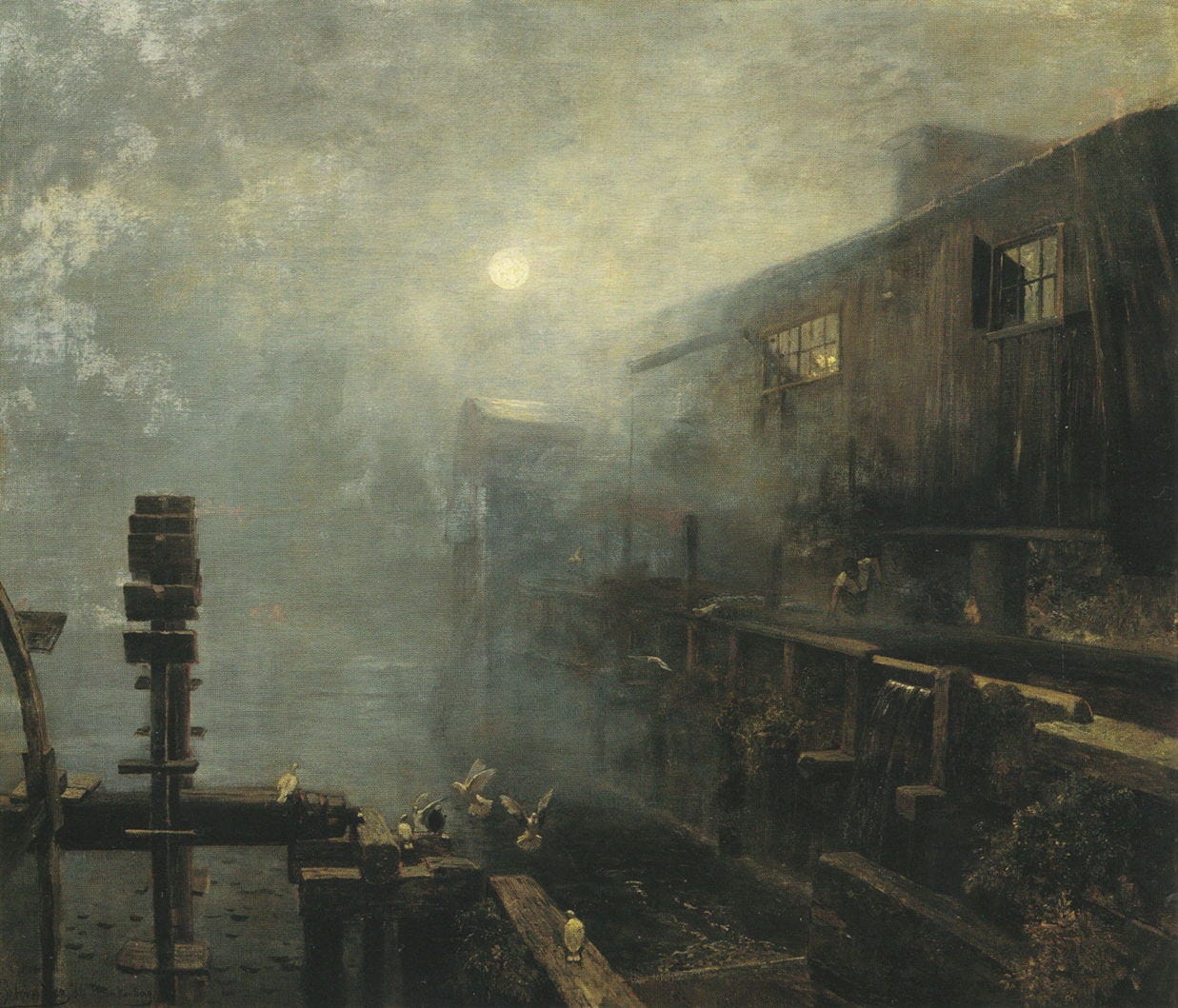
But, like the dreamy, wispy fog, I too am drifting. And how good it is just to drift! All the observations so painstakingly noted and memorized evaporate as I leave my place of contemplation to amble homeward. They evaporate, yet they are not lost. The essence remains, stored away in one’s intangible parts, and when they are needed they will appear, like well-trained servants.
—Henry Miller, Big Sur and the Oranges of Hieronymus Bosch
We took chilly trips to the beach or wharf or aquarium on our bikes or chaperoned by someone’s parents. Briny sea mist cast up effervescent from the granite shoreline teased drooping tendrils of marine layer. Ebb tide dotted the coves at Asilomar with pale mirrors of overcast that on approach turned to curiosity cabinets: miniature pools arrayed with showy specimens of green anemone, purple urchin, ochre starfish, mauve sand dollar, shore and hermit crab, sea snail, sandcastle worm, camouflage chiton, striped limpet, gooseneck and pink acorn barnacle, black mussel, blue-black abalone.
This journey through the forest shut in by the mist gradually led Grange towards his pet daydream; he saw in it the image of his life: he was carrying with him everything he possessed; twenty paces away the world became obscure, perspectives were blocked off, there was nothing more around him but this little halo of lukewarm consciousness, this nest cradled high up above the indistinct ground.
—Julien Gracq, Balcony in the Forest (trans. Richard Howard)
A traditional Ohlone song for warding off fog was recorded by anthropologist Alfred Kroeber in Monterey in 1909. The song was performed by Maria Viviena Soto (then 78) and her niece Jacinta Gonzales and recorded on wax cylinders preserved in the Hearst Museum of Anthropology archives at UC Berkeley. The chant is an urgent, familiar address: “Hey, fog, go home. / Go home, fog. / Pelican is beating your wife.” Both singers died nine years later in the Great Influenza Pandemic.2
we were trying to live a personal life
and yes, that was the only life
we could bear witness to

But the great dark birds of history screamed and plunged
into our personal weather
They were headed somewhere else but their beaks and pinions drove
along the shore, through the rags of fog
where we stood, saying I

—Adrienne Rich, “In Those Years”
From the end of the Coast Guard jetty the harbor foghorn blared intermittent warnings of hazardous conditions to mariners. The siren’s deep brassy tone would permeate through the waterfront, its sound conjuring phantom banks of fog in the imaginations of residents in their homes as they went about household chores or chatted on long distance phone calls or flipped TV channels or went down for midday naps. Drivers passing through the Lighthouse Avenue tunnel between Old and New Monterey honked their car horns in imitation and sent echoes bouncing off the tiled walls and ceiling and out the tunnel’s mouth to join the cacophony of barking sea lions under the pier.
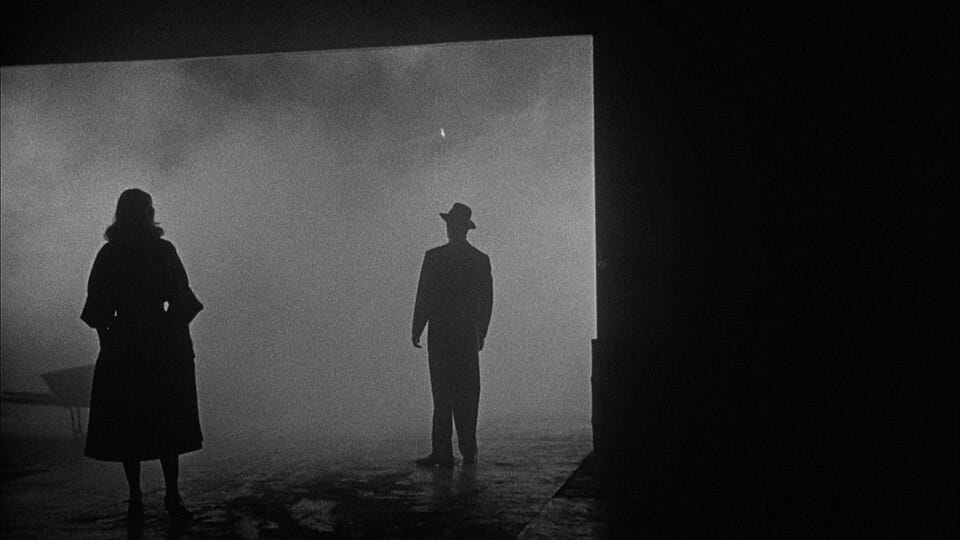
A common atmospheric effect, fog suffuses cinema from gothic thrillers to film noir to war movies and modern day horror. Alfred Hitchcock’s 1940 adaptation of Daphne du Maurier’s Rebecca opens with an iconic shot of fog darkening a full moon as Joan Fontaine narrates: “Last night I dreamt I was at Manderley again.” Humphrey Bogart sees off Ingrid Bergman at the airport in Casablanca, watching her biplane disappear into thick gray fog before he turns and walks into the same murky gray with Claude Rains to begin their “beautiful friendship.” John Carpenter’s 1980 The Fog brings maritime ghosts to a small coastal town in California. A 2007 adaptation of Stephen King’s The Mist besieges a Maine community with otherworldly monsters. In the final scene of his 2013 adaptation of F. Scott Fitzgerald’s The Great Gatsby, Baz Luhrmann lingers on the ghostly green dock light blinking through fog as Tobey Maguire narrates the conclusion of his memoir from a sanatorium—a framing device taken by Luhrmann from Fitzgerald’s unfinished novel The Love of the Last Tycoon.
MALVOLIO  I am not mad, Sir Topas. I say to you this
house is dark.

FOOL  Madman, thou errest. I say there is no darkness
but ignorance, in which thou art more puzzled than
the Egyptians in their fog.

—Shakespeare, Twelfth Night, Act 4 Scene 2
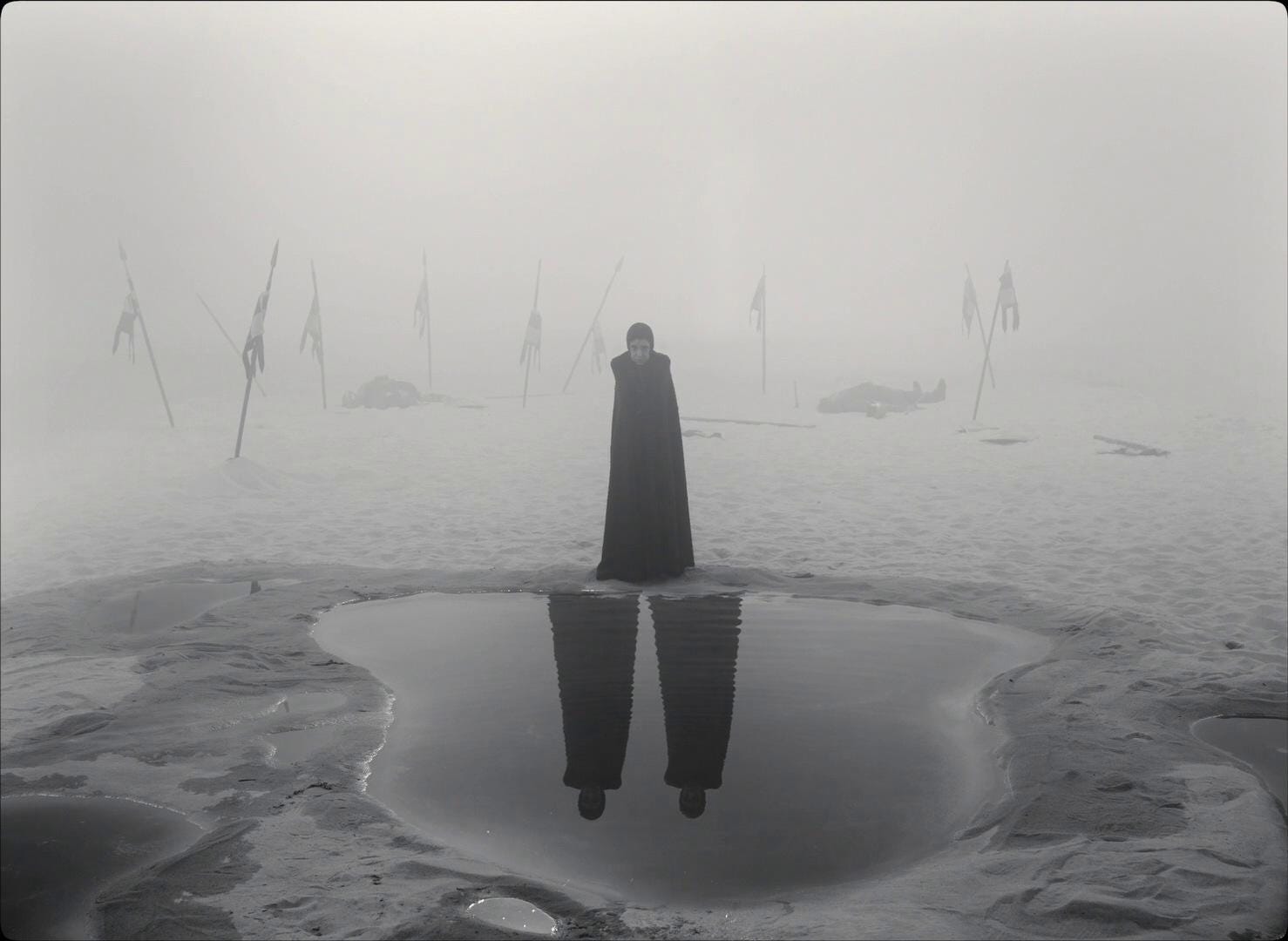
In Shakespeare fog is the medium of curses and contagion: the “filthy air” of the heath where three witches hover in Macbeth; the “contagious fogs” Titania blames for riparian floods and agricultural ruin in A Midsummer Night’s Dream.
Fog comes to Carl Sandburg “on little cat feet,” sits “on silent haunches / and then moves on.”
T. S. Eliot invokes similarly feline imagery with his “yellow fog that rubs its back upon the window-panes,” and in The Waste Land describes postwar London (like Baudelaire’s Paris) as an “Unreal City, / Under the brown fog of a winter dawn.”
Julien Gracq calls his foggy peninsula “not so much a landscape as a deep dream,” an unreal resting place beneath an “opaque veil,” and virgin forest creates a “fleecy labyrinth of fog,” evening scene of the moon’s “delicate, luminous ruses.”3
John Steinbeck’s Salinas Valley is shut off from the world by the “gray-flannel fog of winter,” its yellow foothills and stubbled fields and river willows aflame with yellow leaves in the pale light of radiation fog that sat on the surrounding mountainsides “and made of the great valley a closed pot.” In his Log from the Sea of Cortez the author recounts a dense white fog foreshadowed by nightmare and accident, that appears on “ominous glassy water” in a “steel-gray” dawn and cuts off skiff from boat, lighthouse and shore. Though terrified by the incident their skiff grounds on a sandbar which is, they discover when the fog lifts, just a quarter mile from their intended destination.
Everything is the same, the fog says “We are fog and we fly by dissolving like ephemera,” and the leaves say “We are leaves and we jiggle in the wind, that’s all, we come and go, grow and fall”—Even the paper bags in my garbage pit say “We are man-transformed paper bags made out of wood pulp, we are kinda proud of being paper bags as long as that will be possible, but we’ll be mush again with our sisters the leaves come rainy season”—The tree stumps say “We are tree stumps torn out of the ground by men, sometimes by wind, we have big tendrils full of earth that drink out of the earth”—Men say “We are men, we pull out tree stumps, we make paper bags, we think wise thoughts, we make lunch, we look around, we make a great effort to realize everything is the same”—While the sand says “We are sand, we already know,” and the sea says “We are always come and go, fall and plush”—The empty blue sky of space says “All this comes back to me, then goes again, and comes back again, then goes again, and I don’t care, it still belongs to me”—The blue sky adds “Dont call me eternity, call me God if you like, all of you talkers are in paradise: the leaf is paradise, the tree stump is paradise, the paper bag is paradise, the man is paradise, the sand is paradise, the sea is paradise, the man is paradise, the fog is paradise”—Can you imagine a man with marvelous insights like these can go mad within a month?
—Jack Kerouac, Big Sur
My mother was afraid of fog. When they were looking for a house my parents chose our more affordable neighborhood in Seaside because, she told me, that part of the bay got more sun. She had grown up in Santa Barbara, where mild June glooms gave way to blue skies and ample sunshine by high summer. Preparing for our annual family vacation to Disneyland, my parents would disagree over which route to take. She’d advocate for the scenic coastal drive along the 101, while my father (always the driver of the family station wagon) preferred the quicker inland route on the busy I-5. Her argument encompassed the benefits of pleasant scenery, lighter traffic, a chance to stop at the historic Barnsdall-Rio Grande Filling Station in Goleta, where her father had worked as caretaker for the then operational Ellwood Oil Field.4 But the real impetus for her persuasive rhetoric eventually became clear: she harbored grave fears about the Central Valley’s legendary tule fog.5 Reports of fatal multi-car pileups in the Grapevine and I-5 corridor flashed like chilling premonitions on the local news. Sometimes she won out, and we took a leisurely trip down the coast; other times he did, and we white knuckled it south.
World of Mist. The primordial underworld realm of Norse myth, Niflheim is a “wasteland of freezing mist and fog populated by monsters,” where the goddess Hel presides over dead souls.6 Nifl (Icelandic for “mist”), the Old English nifol (meaning “dark or gloomy”) and the Old High German nebul (“fog”) are all cognates descending from the Proto-Indo-European root nebos, meaning “cloud.” From this cloud emerged the Middle English “nebulous,” antecedent to our modern “nebula”—initially a medical term for cataracts, later an astronomical term for the luminescent region of an interstellar gas cloud.
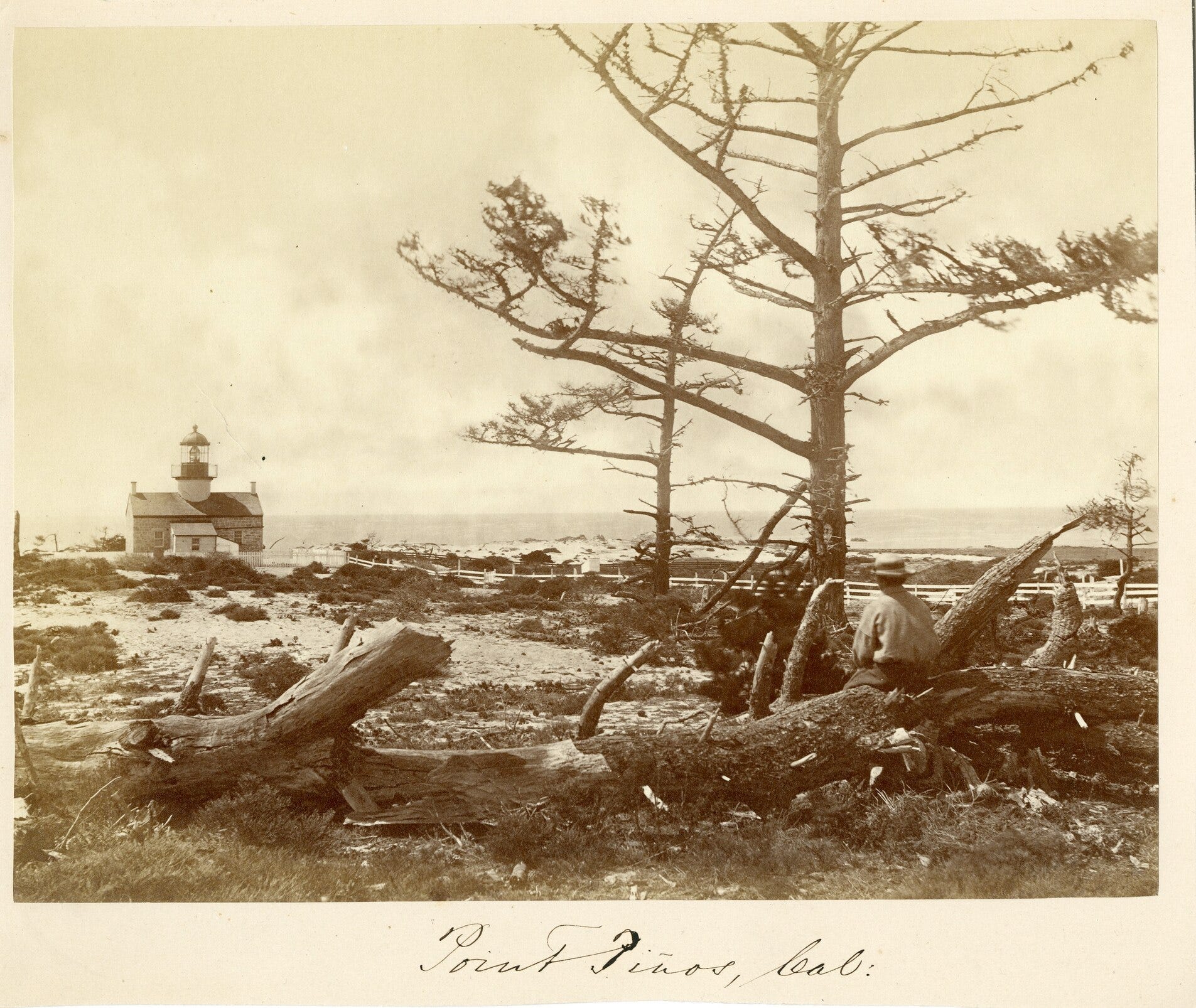
At the cemetery by Point Piños Lighthouse in Pacific Grove, a quiet plot tucked between Asilomar beach and a small stretch of golf links, I was startled by a herd of black-tailed deer as a little girl. I can’t remember anymore why I was there or how old I was or what I was doing on the manicured grass. I was absorbed in some make believe or otherwise entertaining myself, and though I must have been supervised by a nearby adult, in my memory I am alone. Perhaps my awareness was circumscript because I was still very young, a toddler whose world barely extended beyond the proximate; or because the cemetery was ringed by woolly fog that muffled any sound or motion that might have drawn my attention. Through this ring a half dozen or so feral deer broke as if from thin air, landing next to me on the grass where they froze, as surprised by my presence as I was by their arrival. I was still a small child and probably not visible to them behind the headstones and fog. The deer and I watched each other. A doe was close enough to touch. I was still considering this when in one fluid motion they all sprang away, back into mist. I’ve sometimes wondered what my earliest memory is, and it’s possible this is it. It is an unusually vivid childhood memory, and I can still almost feel the damp of the air, hear the surf on the rocks in the near distance, see the doe’s black marble eyes and long perked ears. Yet there is a quality of unreality to the memory too; its ethereal atmosphere and total unmooring from concrete details make it difficult to affirm. It’s a memory that is almost indistinguishable from a dream.
...A flight of pelicans
Is nothing lovelier to look at;
The flight of the planets is nothing nobler; all the arts lose virtue
Against the essential reality
Of creatures going about their business among the equally
Earnest elements of nature.
—Robinson Jeffers, “Boats in a Fog”
If you enjoyed this post you might like...


readings
Julien Gracq, The Peninsula (trans. Elizabeth Deshays), Green Integer, 2011
Jack Kerouac, Big Sur, Penguin, 1992
Jules Michelet, The Sea (trans. Katia Sainson), Green Integer, 2012
Edward F. Ricketts and Jack Calvin, Between Pacific Tides: An Account of the Habits and Habitats of Some Five Hundred of the Common, Conspicuous Seashore Invertebrates of the Pacific Coast Between Sitka, Alaska, and Northern Mexico, Stanford University Press, 1960
John Steinbeck, “The Log From the Sea of Cortez” and “The Long Valley,” The Grapes of Wrath and Other Writings 1936-1941, Library of America, 1996
Brass or bronze nautical bells were used to mark crews’ watches, and also served as simple fog warning systems before the development of mechanized foghorns and sirens.
A video recording of Ramaytush Ohlone Tribal Board Member Gregg Castro performing The Fog Song is available at the US National Park Service website.
See Julien Gracq’s Abounding Freedom (trans. Alice H. Yang) and The Peninsula (trans. Elizabeth Deshays).
Some oil tanks at Ellwood had been the target of an unsuccessful shelling attack by the Japanese Navy during World War Two. Submarine gunners missed the tanks, instead inflicting collateral damage to a nearby well and pump equipment.
Named for tulares (from the Nahuatl tullin), the historic tule rush wetlands in the Central Valley. Once an abundant, biodiverse complex of freshwater habitats that supported one of the largest populations of Native Americans in North America, the wetlands vanished in the late 19th century with the arrival of agricultural irrigation, upriver dam projects and farm and real estate development.
Tule fog continues to be the primary cause of weather-related accidents in California, a national leader in vision-impaired vehicle collisions.
See the entry on “Fog” in Taschen’s The Book of Symbols: Reflections on Archetypal Images.