
on oranges
ripeness and rot

What is “the history of ideas”?
One orange.
—Gilbert Sorrentino, “Seminar,” The Orangery
The earth is blue like an orange
—Paul Éluard, “La terre est bleue” (trans. Stuart Kendall)
Probably the best way to eat an orange is to pick it dead-ripe from the tree, bite into it once to start the peeling, and after peeling eat a section at a time.
—M. F. K. Fisher, The Art of Eating
Eat this sweetish segment or spit it out. You are free.1
—Anthony Burgess, A Clockwork Orange
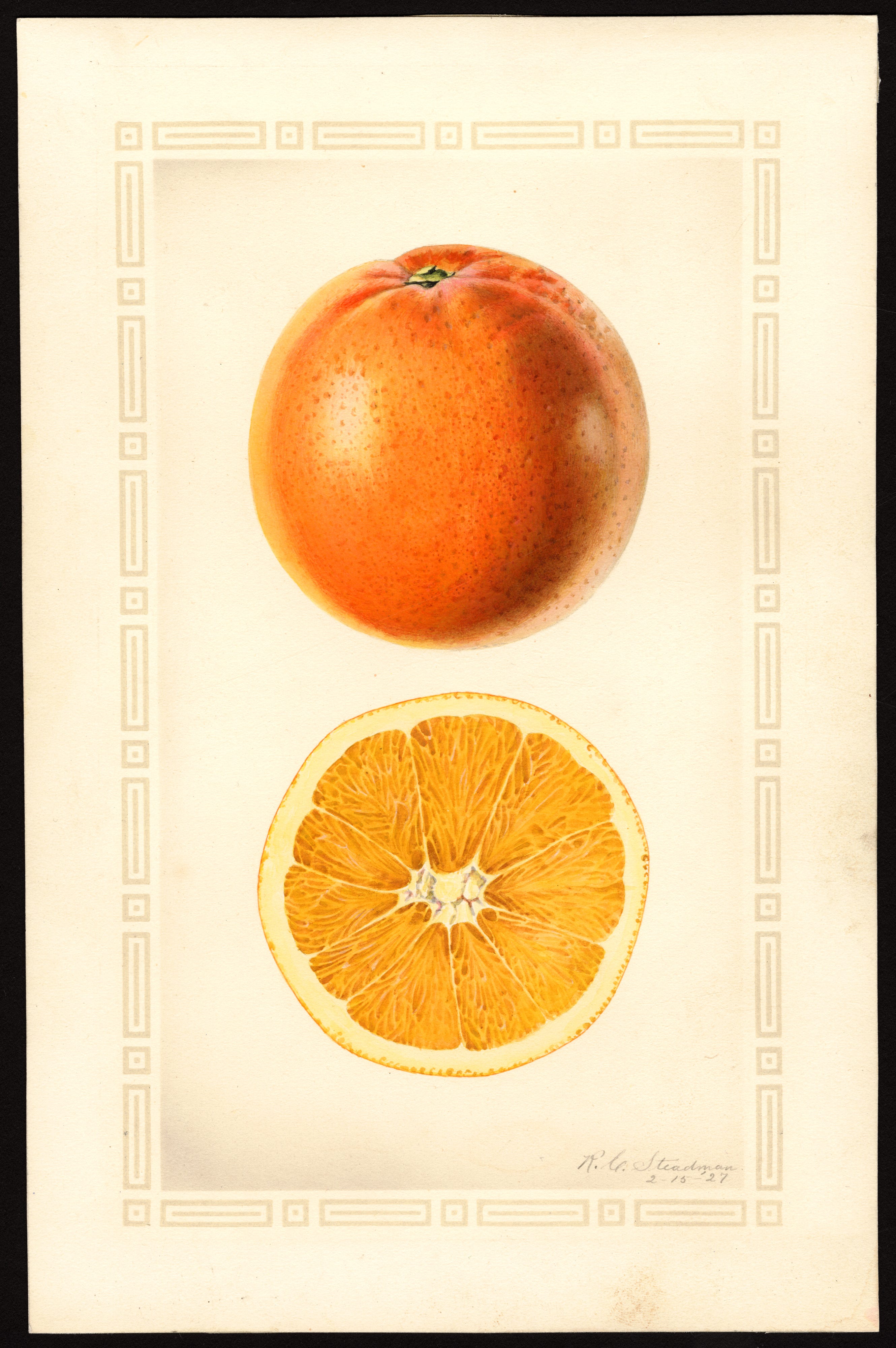
How do we know when an idea is ready to be used? We have many passing thoughts and ideas, of course, that can be quickly put to use or discarded without hesitation. Certain ideas are slower, take longer to mature, but with proper care and time to develop, will yield greater bounties. Any longterm project will naturally attain more variety and depth than an ephemeral assignment. Novel or navel orange, the promise of a fruitful harvest tantalizes. We keep checking the progress of fruition, which happens somehow automatically, it seems, though we’re periodically tending, pruning and otherwise providing optimal conditions for growth. Patience is essential in the garden. It’s tempting to cull precocious fruits, but do this too early or too often and you risk spoiling your crop. Wait too long to pick, on the other hand, and lose your produce to windfall, wildlife, or vandals. And then, as any horticulturist will tell you, spoilage hardly needs our assistance. Rot is at least as inevitable as ripeness—and doesn’t it feel, at times, even more so? However fecund our plot, there are so many and more prolific adversities, whether in the form of blight or pests or frost or drought. So, you could rightly ask, why bother? We can’t all be farmers. Leave the tilling and seeding and weeding and composting, the almanacs and weather monitoring, the grafting and irrigation and crop rotation, the harvesting and sorting and canning and taking to market, to those who know what they’re doing. You could make a compelling argument. Until, that is, in some backyard orchard or community garden you happen to pass on your afternoon walk, you come across an ordinary looking sweet orange tree, a Valencia perhaps, if you’re lucky, dotted with fragrant white blossoms alongside plump, bright citrus glowing in the honeyed postmeridian sunlight, and without even a thought you reach up and pluck one perfectly round, weighty fruit dangling from a lower branch, bite experimentally into the zesty rind, and from your crude incision begin to disrobe the pithy segments and pop each one, bursting with tart juice, into your electrified mouth. You see, there’s simply nothing in the world like a well-timed orange.
Any art that achieves finality or perfect fruition cannot evade the consideration of sensuality. The distinction, in fact, between the sensible and the sensuous is not as clear as we might suppose.
—Mark Rothko, The Artist’s Reality: Philosophies of Art
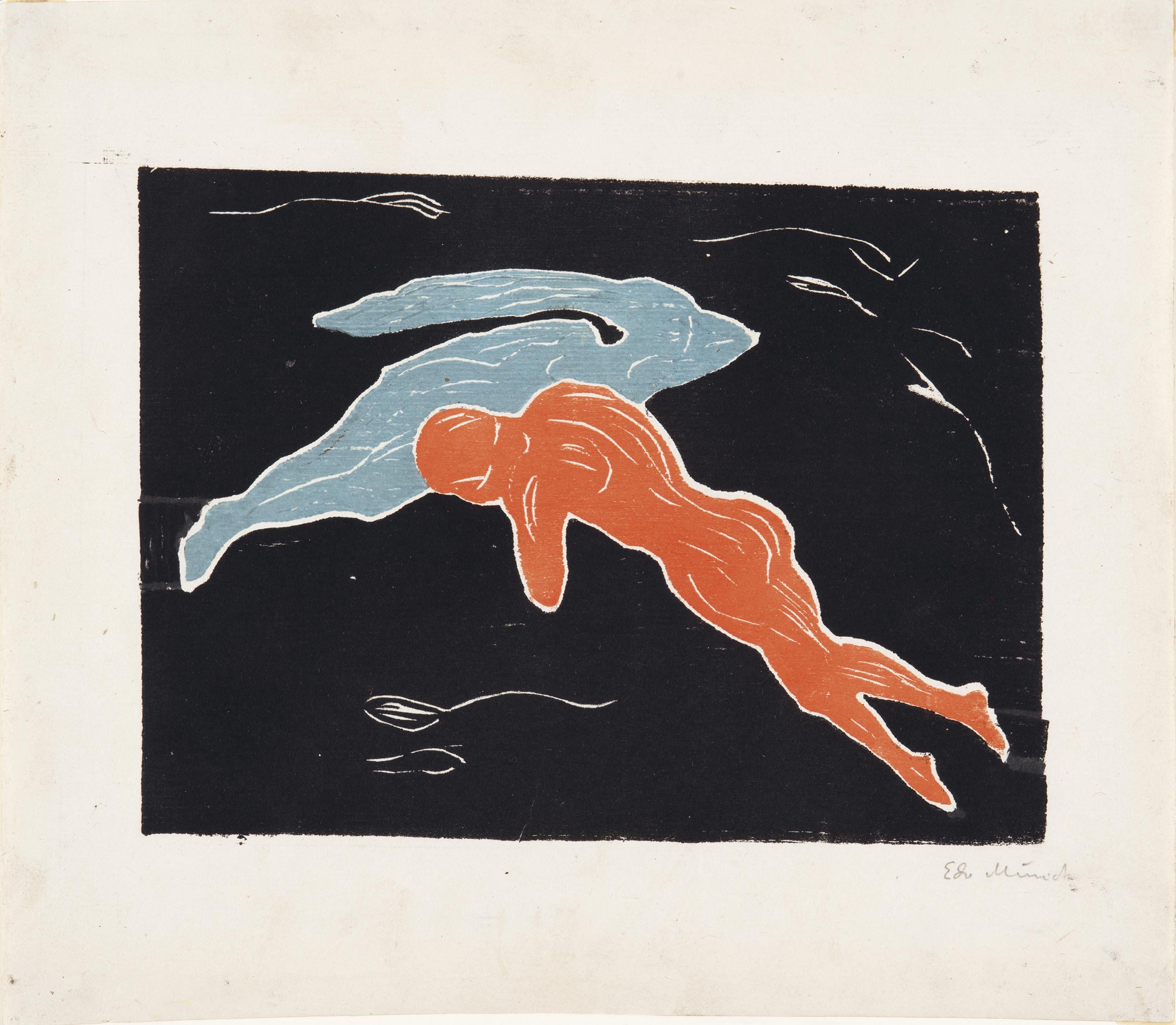
In seventeenth century Portugal and Spain, navel oranges were called pregnant oranges, perhaps because the “navel” is actually a small secondary fruit that grows in the blossom end. Navels thrive in California, “where cool nights and warm days produce brilliant skin color and the right balance of sugar and acid.”2
The oranges of Bosch’s “Millennium,” as I said before, exhale this dreamlike reality which constantly eludes us and which is the very substance of life. They are far more delectable, far more potent, than the Sunkist oranges we daily consume in the naive belief that they are laden with wonder-working vitamins. The millennial oranges which Bosch created restore the soul; the ambiance in which he suspended them is the everlasting one of spirit become real.
—Henry Miller, Big Sur and the Oranges of Hieronymus Bosch
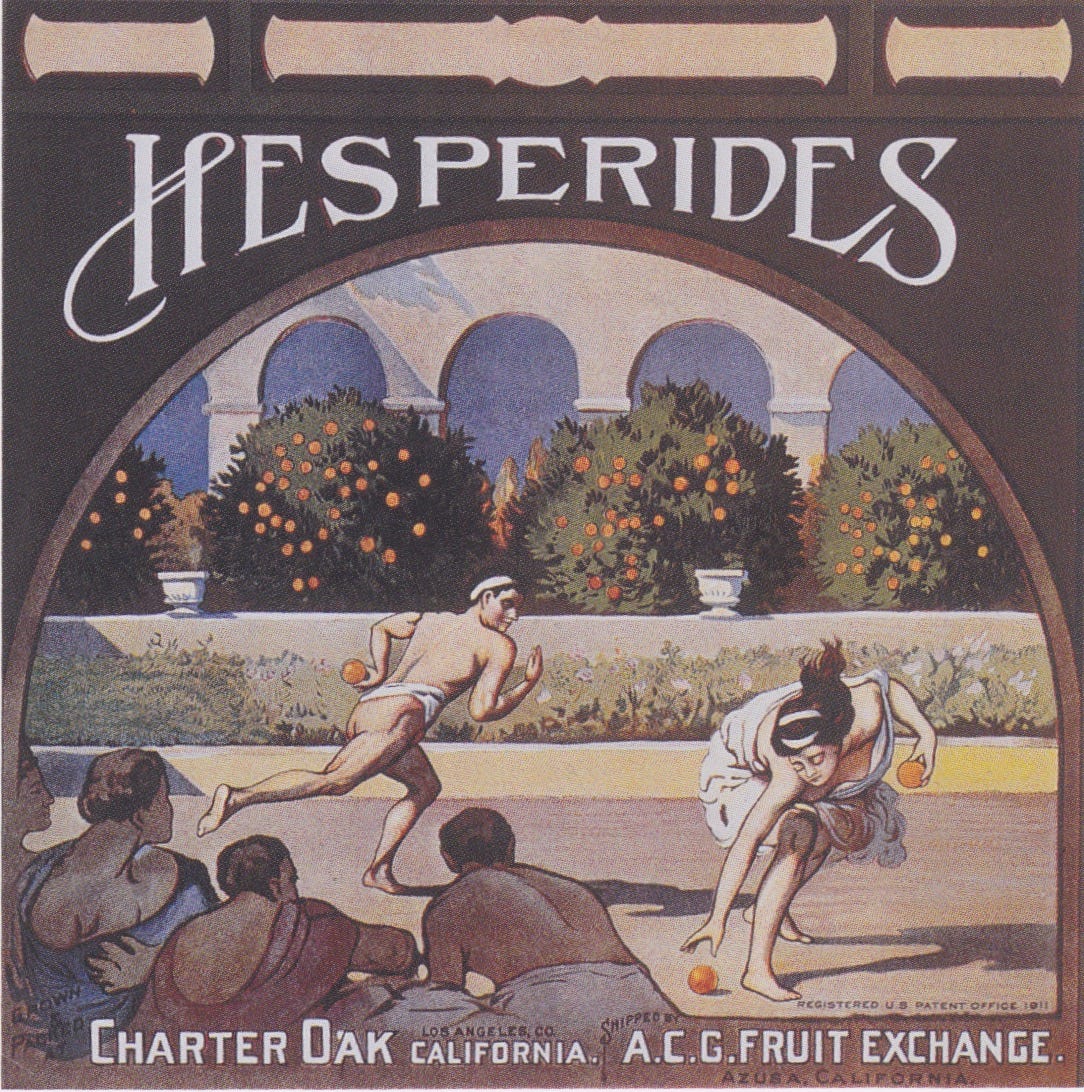
Citrus x sinensis. Land developers in Southern California lured settlers here at the turn of the 20th century with the promise of a second gold rush: fresh homegrown oranges on trees in every backyard. The first to plant citrus in the region were the Spanish padres who brought them to California missions more than a century earlier.3 By the time I arrived in Los Angeles just over fifteen years ago, most commercial orchards in the area had long since disappeared, their fruit trees harvested for firewood and land parceled out to real estate investors.4 Remnants of the “Orange Empire” are still visible in backyard trees and surviving victory gardens across the county, and in historically preserved groves such as the Huntington Botanical Gardens orchard, where 500 Valencia orange trees were originally planted by Henry E. Huntington in 1903.5
As for planting and grafting, the original pattern for these operations was provided by creative nature herself, since fallen berries and acorns in due time produced swarms of seedlings beneath the trees; and this gave people the idea of entrusting slips to branches and of planting young saplings in the earth all over the countryside. Then they kept on experimenting with new methods of cultivating the little plot of land they loved, and saw wild fruits improve in the ground in response to their kindly care and coaxing. And day by day they forced the forests to retreat farther and farther up the mountains and surrender the parts below to cultivation, so that on hills and plains they might have meadows, ponds, streams, crops, and exuberant vines, and so that the distinctive gray-green zone of olives might run between, spreading over down and dale and plain. They created landscapes such as we see today—landscapes rich in delightful variety, attractively dotted with sweet fruit trees and enclosed with luxuriant plantations.
—Lucretius, On the Nature of Things (trans. Martin Ferguson Smith)
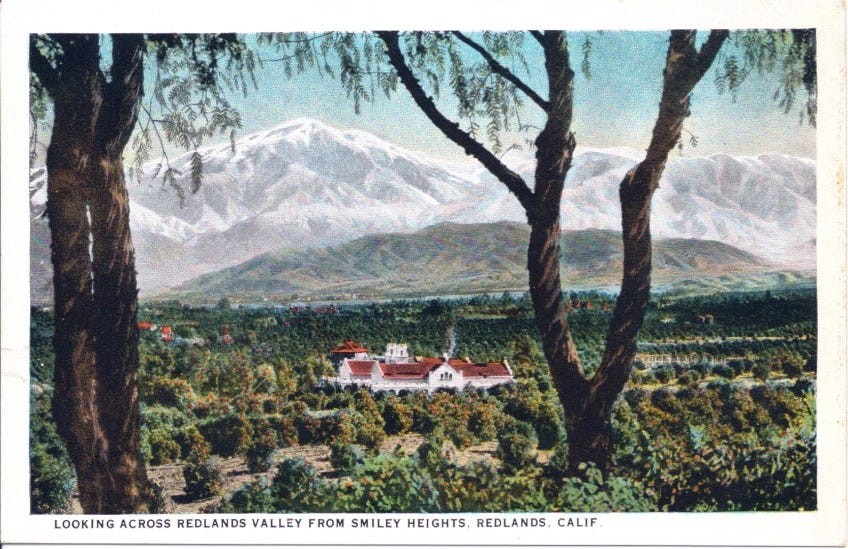
Redlands, 60.2 m. (1,350 alt., 14,324 pop.), is a college town, and fruit-packing center surrounded by more than 15 thousand acres of citrus groves. In the 1937-38 season this area produced approximately 4,200 cars of navel oranges and 1,300 cars of Valencia oranges, worth six million dollars. Near the business area the palm-lined streets are bordered with small houses and flower gardens. Wealthy easterners, attracted by the winter climate and the setting of snow-capped mountains rising above green orange groves, have built palatial winter homes surrounded by acres of landscaped grounds on the hills in the southern part of town.
Before 1881 when E. G. Judson and F. E. Brown sponsored the digging of a canal, six miles long, from the Santa Ana River to a reservoir in the mouth of the Yucaipa Valley, to the east, the region was a semi barren mesa called Redlands for the color of its soil. A year after the canal’s completion, 1,500 acres of orange groves were planted here and 120,000 grapevines were set out by Dr. J. D. B. Stillman on a 100-acre area at Lugonia, several miles to the north. In four years these produced so heavily that a winery was built. Redlands, Lugonia, and other small settlements near by were incorporated as one community in 1881 and given the name of Redlands.6
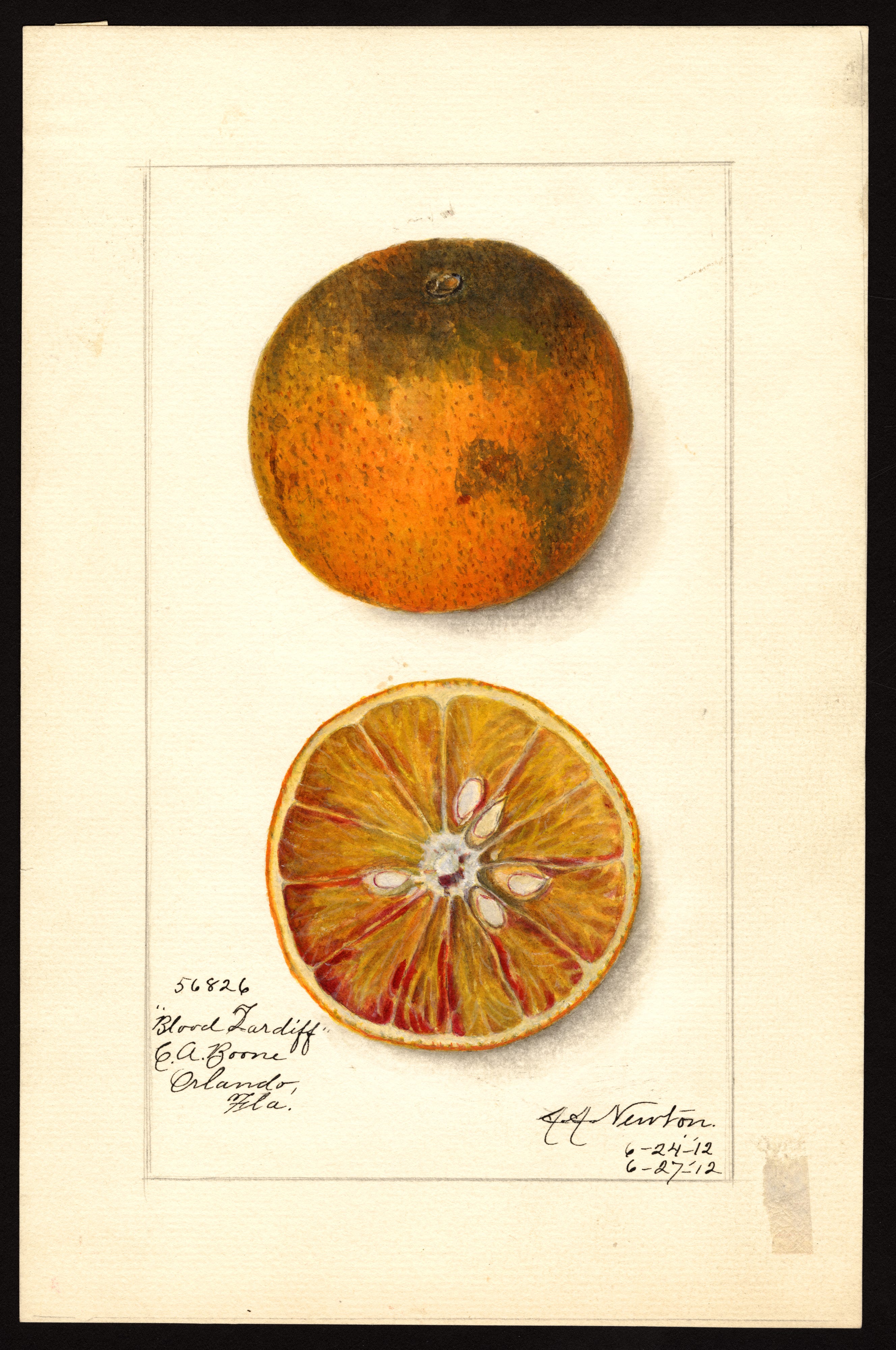
Blood oranges grow well in Florida, but they frighten American women.7
—John McPhee, Oranges
I wasn’t thinking about oranges when I moved into the narrow converted bedroom I’d rented in Sawtelle, a neighborhood just across the 405 and a short bike ride to the UCLA campus. Needing book shelves and searching for cheap options on Craigslist, I came across a listing for several vintage wooden orange crates—milk crates were a familiar shelving strategy: inexpensive, modular, interchangeable, and conveniently portable whenever it came time to move—in Redlands, a city near the foothills of the San Bernardino Mountains. Named for its red adobe soil, I learned on Wikipedia, Redlands was once a major center of citrus production and, in the early 20th century, the world’s largest producer of navel oranges. I looked up directions and found I’d have at least a 90 minute drive just to get there. An indulgent road trip, but the prospect of salvaging the old crates was somehow irresistible to me, as if I was being magnetically drawn towards the unreachable glory of the past. Feeling adventurous, I made the trip to the “Jewel of the Inland Empire,” paid the bemused seller in cash for the weathered crates, stacked them snugly in the trunk and backseat of my Saturn SL, and drove back through the valley, past the southern and eastern portions of Greater Los Angeles’s Transverse Ranges. My cargo of artifacts from defunct orchards knocked sides softly in the back, waiting to be packed with a new kind of pulp.
This little orchard will be a part of a great holding next year, for the debt will have choked the owner.
This vineyard will belong to the bank. Only the great owners can survive, for they own the canneries too. And four pears peeled and cut in half, cooked and canned, still cost fifteen cents. And the canned pears do not spoil. They will last for years.
The decay spreads over the State, and the sweet smell is a great sorrow on the land. Men who can graft the trees and make the seed fertile and big can find no way to let the hungry people eat their produce. Men who have created new fruits in the world cannot create a system whereby their fruits may be eaten. And the failure hangs over the State like a great sorrow.
The works of the roots of the vines, of the trees, must be destroyed to keep up the price, and this is the saddest, bitterest thing of all. Carloads of oranges dumped on the ground. The people came for miles to take the fruit, but this could not be. How would they buy oranges at twenty cents a dozen if they could drive out and pick them up? And men with hoses squirt kerosene on the oranges, and they are angry at the crime, angry at the people who have come to take the fruit. A million people hungry, needing the fruit—and kerosene sprayed over the golden mountains.
And the smell of rot fills the country.
—John Steinbeck, The Grapes of Wrath
John Steinbeck, in other words, wrote The Grapes of Wrath (his wife Carol selected the title, pulling the phrase from Julia Ward Howe’s “Battle Hymn of the Republic”) as, to all outward appearances, a prosperous literary celebrity ensconced in suburban comfort. Just over the mountains, as he wrote his agent Elizabeth Otis in February, “there are about five thousand families starving to death over there, not just hungry but actually starving.” Steinbeck was destined to make an awful lot of money from dramatizing their misery, one of the enduring paradoxes in American literary history.
—Kevin Starr, Endangered Dreams: The Great Depression in California
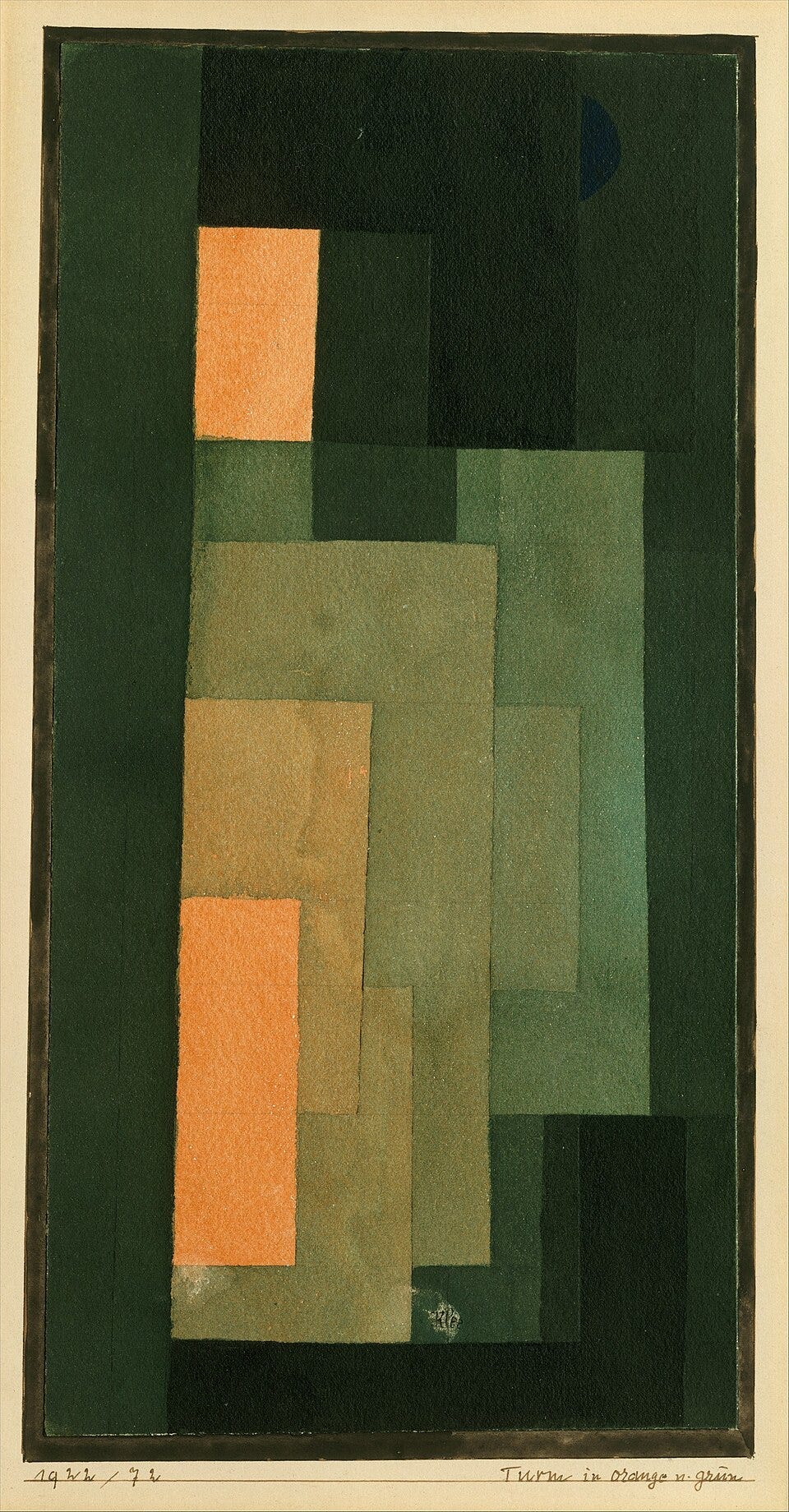
“Orange is red brought nearer to humanity by yellow,” says Kandinsky. “This blend brings red almost to the point of spreading out towards the spectator. But the element of red is always sufficiently strong to keep the color from flippancy. Orange is like a man, convinced of his own powers. Its note is that of the angelus, or of an old violin.” Writing on form and color in his 1911 metaphysical treatise Concerning the Spiritual in Art, the painter sketches a synesthetic, mystical theory of art in which “every object has its own life and therefore its own appeal; man is continually subject to these appeals. But the results are often dubbed either sub- or super-conscious. Nature, that is to say the ever-changing surroundings of man, sets in vibration the strings of the piano (the soul) by manipulation of the keys (the various objects with their several appeals).” For Kandinsky, abstract art is the ultimate, spiritual expression of the music of painting.8
Various objects with their several appeals: Imperial topaz, fire opal, amber, darker citrines, the paler end of carnelian, orange jasper, toxic wulfenite prized by collectors; monarch butterflies, Bengal tigers and orange tabbies; California poppies, Humboldt and tiger lilies, nasturtium, monkey flower, marigold, spiky bird of paradise, apricot desert mallow; Aleuria aurantia, otherwise known as orange peel fungus (named for its eerie mimicry of discarded citrus peels), and of course chanterelles, and their poisonous impostor the Jack-o’-lantern mushroom; harvest moons; pumpkins and apricots; Proust’s special orangeade, and Lizzie Borden’s favorite orange sherbet. 1950s couture glamorized loud orange gowns, coats and capes. Boccaccio’s Decameron is laced with the delicate fragrance of orange blossoms blooming in the orchards of its Florentine setting, or placed in floral nosegays and ample bouquets used to perfume bedrooms, or else distilled into orange flower water for bathing lovers. And then, did you know that some scholars argue the “golden apple” given by Paris to Aphrodite was in fact an orange, or that the “apple” in the Song of Solomon, and the unspecified forbidden fruit eaten by Eve in the Garden of Eden, could well have been an apricot, or an orange? The oranges in Leonardo Da Vinci’s The Last Supper, on the other hand, are an anachronism; a newly arrived product in Renaissance Europe, oranges weren’t cultivated in the Middle East until the 9th century, and it’s unlikely Jesus would have seen an orange in his lifetime. The orange is the only fruit to give its name to a color, a nomenclature which coincided with its arrival in Europe, where Western languages had previously referred to that shade as “yellow-red” or “tawny.”9
Persimmons ripen late in the fall, and the brilliant orange fruits hang on the trees even after the leaves have fallen. A persimmon tree full of fruit can be a spectacular sight sparkling against a deep blue autumn sky.
—Alice Waters, Chez Panisse Fruit
Diospyros kaki. Conventional grocery stores carry mainly Fuyu persimmons, or the astringent acorn-shaped variety Hachiya. But thousands of subtropical persimmon cultivars exist in China and Japan, where the fruit has been cultivated for over two millennia. Japanese immigrants brought around five hundred varieties to California over the course of a 50-year planting spree from 1870 to 1920.10 While a few of these are grown commercially, most survive in backyard gardens, private orchards or nurseries. I’ve lived by two persimmon trees: a Hachiya in West Los Angeles and a Fuyu in West Adams.11
Hoshigaki. Dried persimmons are auspicious in Japan, where they’re used, along with the daidai (a Japanese bitter orange), on Kagami mochi for New Year ritual decorations. The traditional drying method for hoshigaki involves peeling Hachiya persimmons, then hanging or laying them out in the sun for a month or longer and periodically massaging the flesh of the fruit to tenderize fibers and bring sugars to the surface, where it crystallizes into a silvery sheen.12
The Hachiya tree in Sawtelle was likely planted in the interwar period, by the original owners of the small home with a converted guest house where I furnished my rented room with antique orange crate bookshelves. Now known as Little Osaka, the neighborhood was home to a flourishing Issei community in the early 20th century. Denied property ownership by restrictive racial covenants and discriminatory practices in Westwood, Bel Air, Brentwood, and Beverly Hills—areas with affluent white communities that hired Japanese immigrants as landscapers, gardeners, and domestic laborers—many Issei settled in nearby Sawtelle and opened family businesses there. Garden supply stores and nurseries were especially popular small businesses, with as many as twenty nurseries operating at their peak, following the postwar era known as the “resettlement period.”13
Whence then is sweet fruit gathered from the bitterness of life, from groaning, tears, sighs, and complaints?
—St. Augustine, Confessions (trans. E. B. Pusey)
Diospyros virginiana. American persimmons are native to the Southeastern United States and were an important food for Native Americans, who cultivated the fruit and used it to bake persimmon bread. European settlers learned from indigenous horticulturists to eat the astringent cultivar only after the leaves of the tree had fallen and the fruit was very soft. The English word “persimmon” comes from the Algonquian Powhatan name, “pasimenan,” meaning “dried fruit.” Wild persimmons can be found growing along the edges of open fields and abandoned pastures in their native region.
As all things change to fire,
and fire exhausted
falls back into things,
the crops are sold
for money spent on food.
—Heraclitus, Fragments (trans. Brooks Haxton)
Both trees were abundantly productive and would be heavy with fruit when their leaves began to shed in late fall. I only ever sampled a few of the Hachiyas, none of the Fuyus, which grew in a neighbor’s backyard on the opposite side of a concrete masonry wall.14 I ate very few, but I wrote about the persimmons, and still occasionally recall their waxy, saturated orange, stark against dusky leaves. My bedroom window looked out at the Fuyu tree, and I could often hear animals rustling in its branches at night or dawn. Passing bands of brash parrots would visit the tree, and I’d watch their bright green wings flit among leaves as they perched and preened and gorged themselves on early fruit. I remember harvest time, when the persimmons dangled like small, ready lanterns until the neighbors at last collected them all with a fruit picker’s rake, baring winter limbs. Would I have such vivid recollections of the tree if I’d eaten its fruit? Or do the persimmons stay eternally fresh in my memory because, for me, they were always just out of reach, unpicked.
Is there no change of death in paradise?
Does ripe fruit never fall? Or do the boughs
Hang always heavy in that perfect sky,
Unchanging, yet so like our perishing earth,
With rivers like our own that seek for seas
They never find, the same receding shores
That never touch with inarticulate pang?
Why set the pear upon those river-banks
Or spice the shores with odors of the plum?
—Wallace Stevens, “Sunday Morning”
If you enjoyed this post you might like...


readings
An Illustrated Catalog of American Fruits and Nuts: The US Department of Agriculture Pomological Watercolor Collection, ed. Pascale Georgiev, Atelier Éditions, 2021
Jack Fujimoto, Sawtelle: West Los Angeles’s Japantown, Arcadia, 2007
Johann Wolfgang von Goethe, Theory of Colours, trans. Charles Locke Eastlake, MIT Press, 1970
Wassily Kandinsky, Concerning the Spiritual in Art, trans. M. T. H. Sadler, Dover, 1977
Los Angeles in the 1930s: The WPA Guide to the City of Angels, Federal Writers Projects of the Works Progress Administration, University of California Press, 2011
John McPhee, Oranges, FSG, 1977
Gilbert Sorrentino, The Orangery, Sun & Moon Press, 1995
Kevin Starr, Endangered Dreams: The Great Depression in California, Oxford, 1996
John Steinbeck, The Grapes of Wrath and Other Writings 1936-1941, Library of America, 1996
Alexander Theroux, The Secondary Colors, Henry Holt, 1996
Alice Waters, Chez Panisse Fruit, Harper Collins, 2002
From the author’s 1986 introduction to the American rerelease of A Clockwork Orange. The novel’s first edition contained 21 chapters when it was originally published in the U.K., but U.S. publishers refused to include the final chapter for over two decades.
See the “Oranges” entry in Alice Waters’s Chez Panisse Fruit.
Oranges originated in the Himalayas, and the fruit’s migration from East Asia to the Middle East, Europe and the Americas paralleled the growth of civilization, trade routes and the spread of colonialism.
Commercial groves moved inland to the Central and Northern Valleys and deserts. California continues to be the largest citrus producer in the country, although growers face mounting costs due to water allocation challenges, volatile weather and shifts in climate, invasive pests and diseases, and the collapse of large-scale processing operations following private equity acquisitions.
A few of the original trees are alive and still producing fruit over 120 years later.
See Los Angeles in the 1930s: The WPA Guide to the City of Angels.
Blood oranges grown in California are the most “bloody.” See the “Oranges” entry in Alice Waters’s Chez Panisse Fruit.
See Wassily Kandinsky’s Concerning the Spiritual in Art (trans. M. T. H. Sadler).
See John McPhee’s Oranges; the essay on “Orange” in Alexander Theroux’s The Secondary Colors; and the “Citrus” entry in An Illustrated Catalog of American Fruits and Nuts: The US Department of Agriculture Pomological Watercolor Collection.
See the “Persimmons” entry in Alice Waters’s Chez Panisse Fruit.
Los Angeles’s “Sugar Hill.” Following a landmark 1945 civil rights lawsuit lifting restrictive racial covenants, West Adams was home to some of the city’s wealthiest Black residents, including celebrities like Hattie McDaniel, Louise Beavers, Pearl Bailey, Ethel Waters, and Johnny Otis. Construction of the Santa Monica Freeway in the 1960s bisected the neighborhood, and resulted in the displacement of many prominent residents, as well as the demolition of mansions seized through eminent domain.
See the “Persimmons” entry in Alice Waters’s Chez Panisse Fruit.
When the Second World War ended, many Japanese families returning from mass incarceration camps were disappointed to find their homes and businesses ransacked, despite having been entrusted to remaining community members for caretaking in their absence. See Jack Fujimoto’s Sawtelle: Los Angeles’s Japantown.
Apple-sized Hachiya persimmons must be allowed to fully ripen before eating, and are virtually inedible until the flesh of the fruit becomes jellylike and soft enough to eat with a spoon. Sweeter, tomato-shaped Fuyus can be eaten while still crisp, though they will soften and develop deeper flavor with time.