
on greats
heroes and tyrants

The crude commercialism of America, its materializing spirit, its indifference to the poetical side of things, and its lack of imagination and of high unattainable ideals, are entirely due to that country having adopted for its national hero a man who, according to his own confession, was incapable of telling a lie, and it is not too much to say that the story of George Washington and the cherry tree has done more harm, and in a shorter space of time, than any other moral tale in the whole of literature.
—Oscar Wilde, “The Decay of Lying: An Observation”
It was a time of plague and war—the long, draining conflict in the Low Countries, the renewed threat of Spanish invasion. Political divisions, savage executions, unemployment and inflation were widespread. The mood in London was ugly. In times like these people look for a scapegoat, and chief among these were the city’s immigrant traders…
—Charles Nicholl, The Reckoning: The Murder of Christopher Marlowe
And boys, be in nothing so moderate as in love of man, a clever servant, insufferable master.
There is the trap that catches noblest spirits, that caught—they say—God, when he walked on earth.
—Robinson Jeffers, “Shine, Perishing Republic”
On the surface note taking seems a humble occupation. Enthralled by the classics of masters, kneeling in the footnotes and whispering in the margins of the canonical, the notetaker vows never to overstep her clerical status and attempt a masterpiece of her own. We should be wary of humility. The very virtue is a contradiction, “the truth in masquerade,” another rakish reliable narrator might say;1 the reward for being humble is, after all, the right to claim that quality of virtuousness—and longing to be good is just pride disguised. Worse still, the notetaker’s secret wish is to be not merely good, but great. How else to explain her constant fawning on “the choice and master spirits,” grasping at the hems of their finer garments.2 Little more than an obsequious apprentice, she’s all but indistinguishable from run-of-the-mill sycophants and hangers-on who place themselves within the orbit of whatever influence is most expedient. Because in this fallen world the only incentive for studying greatness is itself. Knowing this, the notetaker makes her preparations and bides her time, waiting for the first opportunity to usurp authority and claim her coveted title.
For WILL and SHALL best fitteth Tamburlaine,
Whose smiling stars give him assured hope
Of martial triumph ere he meet his foes.
I that am term’d the scourge and wrath of God,
The only fear and terror of the world…
—Christopher Marlowe, Tamburlaine the Great, Part One
Sometime between eleven p.m. and midnight on Saturday, May 5, 1593, an anonymous bill was posted on the wall of the Dutch Churchyard in London’s Broad Street.3 Written in the form of a doggerel ballad, the libel railed against foreigners, blaming Dutch and Jewish merchants for London’s economic problems and characterizing immigrant businessmen as Machiavellian conspirators. The poem’s virulent antisemitic, nationalistic language evokes the wildly popular contemporary plays of Christopher Marlowe, in particular The Jew of Malta—which opened the year before and begins with a prologue delivered by the ghost of Machiavelli (abbreviated as “Machevill”)—and The Massacre at Paris, a sensational staging of the infamous 1572 St. Bartholomew’s Day Massacre that had opened to a packed house just a few months prior, shortly before all theaters were closed due to the plague.4 From anti-immigrant invective the Marlovian libel proceeds to incitement of violence:
Since words nor threats nor any other thing
Can make you to avoid this certain ill,
We’ll cut your throats, in your temples praying,
Not Paris massacre so much blood did spill.
An investigation ensued, drawing several suspects in for interrogation and torture by the Elizabethan government, including Thomas Kyd, a friend of Marlowe’s and the author of the hugely influential revenge play The Spanish Tragedy.5 A surviving manuscript copy of the Dutch Church libel from 1600 is signed, pseudonymously, “Tamburlaine.”
While Kings, in dusty darkness hid,
Have left a nameless pyramid,
Thy Heroes, though the general doom
Hath swept the column from their tomb,
A mightier monument command,
The mountains of thy native land!
There points thy Muse to stranger’s eye
The graves of those that cannot die!
‘Twere long to tell, and sad to trace,
Each step from Splendour to Disgrace;
Enough—no foreign foe could quell
Thy soul, till from itself it fell;
Yet! Self-abasement paved the way
To villain-bonds and despot sway.
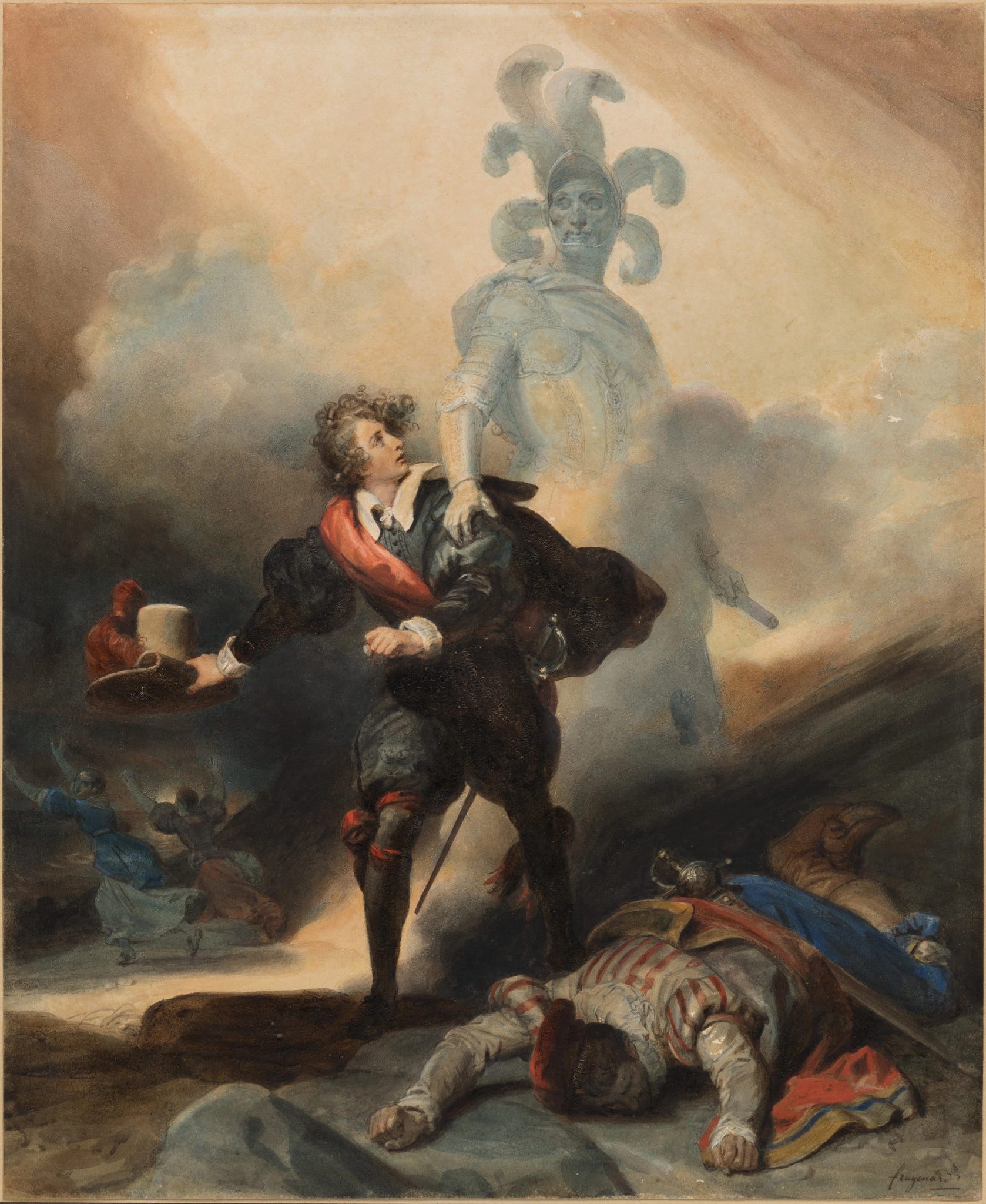
—Lord Byron, The Giaour, A Fragment of a Turkish Tale
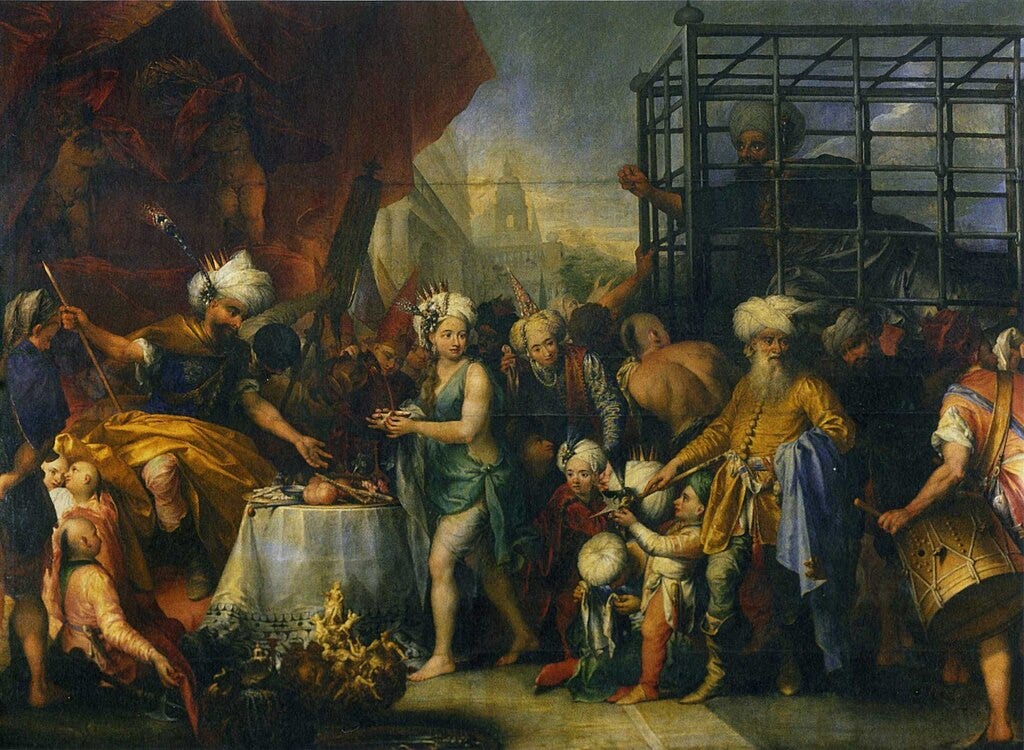
Tamburlaine the Great was Marlowe’s theatrical debut following his controversial exit from Cambridge in 1587.6 A crowd pleasing two-part chronicle of the “remorseless conquests” and “exotic barbarities” of the 14th century Scythian emperor Timur, Tamburlaine was one of London’s first theatrical hits in the early modern period. Audiences were thrilled by the play’s violent subject matter and sensational stage effects. A sequel was in production by the fall of that same year, and soon gained publicity from an accident involving a mistakenly loaded prop caliver used during a firing squad execution scene, resulting in the deaths of a child and pregnant woman in the audience.7 Marlowe would go on to achieve massive commercial success and applied a similar formula to most of his dramatic works. In biographer Charles Nicholl’s assessment:
He gave people what they wanted: spectacular action, exotic locations, patriotic sentiments, plenty of violence. He thrilled them with poetry—his “high astounding terms”, as he put it—and he fascinated them with a series of charismatic heroes who were usually more villain than hero. But for part of his audience, there was always something more than this grand guignol. They heard other more complex messages, that layer of doubt and debate which lies beneath the surface, which at a time of rigorous state censorship had to be beneath the surface. They admired Marlowe, as we do today, for those cool sub-texts of irony and disaffection
This king Timur is one of the greatest and mightiest of kings. Some attribute to him knowledge, others attribute to him heresy because they note his preference for “members of the House (of ‘Ali),” still others attribute to him the employment of magic and sorcery, but in all this there is nothing; it is simply that he is highly intelligent and perspicacious, addicted to debate and argumentation about what he knows and also about what he does not know.
—Walter J. Fischel, Ibn Khaldûn and Tamerlane: Their Historic Meeting in Damascus, 1401 A.D.
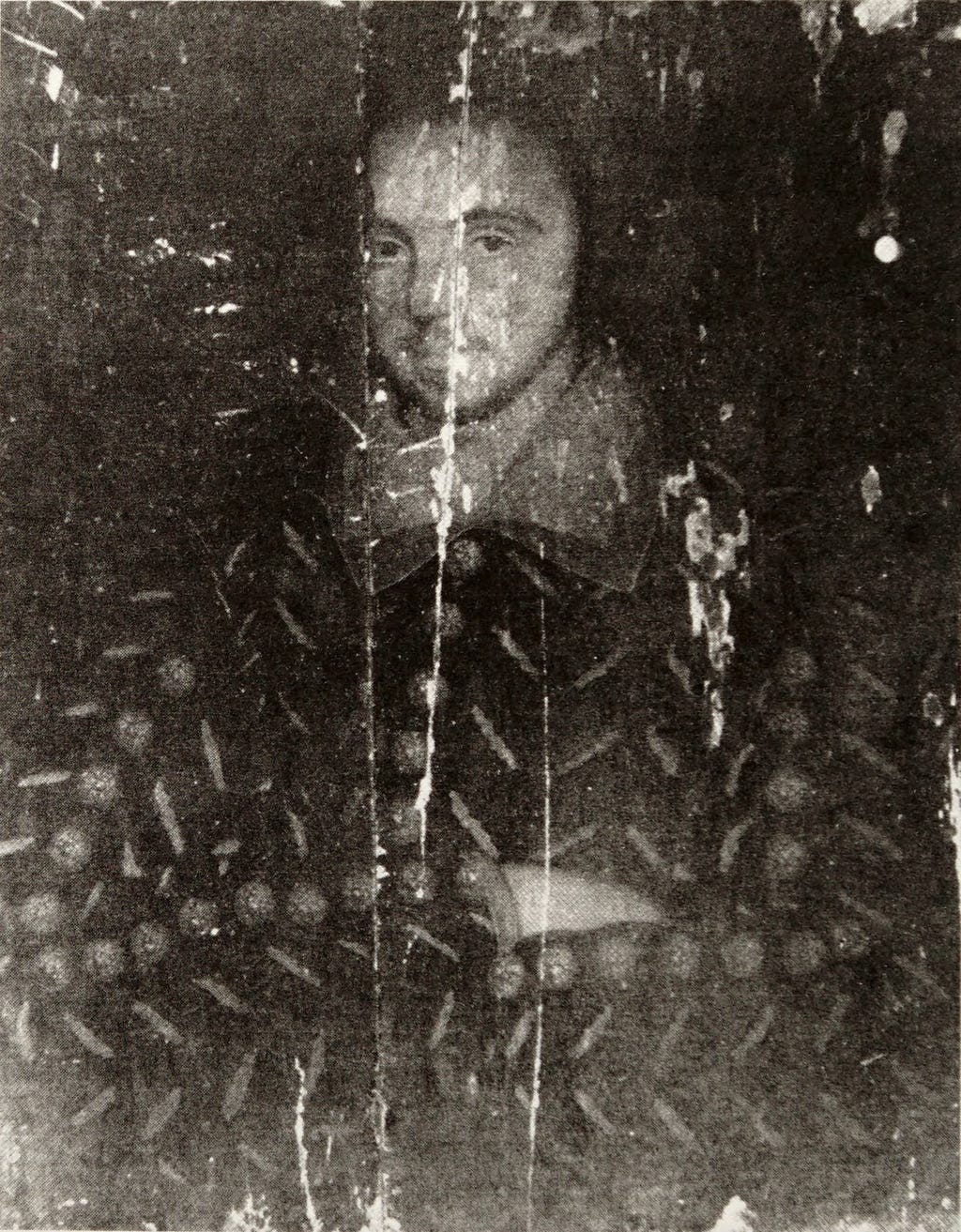
In 1952 or 1953, during renovations of some of the oldest buildings at Cambridge’s Corpus Christi College, an anonymous 16th century portrait was discovered on the backs of two discarded wood panels.8 The panel painting was unsigned, its subject unnamed. An inscription in the upper left corner gives the year and age of the sitter: Anno Dni 1585 / Aetatis Suae 21; below this a phrase in Latin: Quod me nutrit me destruit—a version of a popular Elizabethan motto, commonly accompanied by an impresa of an upside down burning torch, that translates as “That which nourishes me destroys me.”9 The painting is believed to be the sole extant portrait of Christopher Marlowe (the only student at Cambridge in 1585 who was then 21 years old). The Marlowe portrait shares an uncanny resemblance with another portrait of an unknown man that hung in Grafton Manor, a royal lodge in Northamptonshire, until it was removed to a nearby village when the manor was destroyed in 1643. The anonymous Grafton portrait lacks a motto, inscribed with just the year, 1588, and age of the sitter, 24. It was originally owned by Henry Wriothesley, Earl of Southampton, a wealthy patron of various Elizabethan writers, most notably William Shakespeare, who dedicated two narrative poems to him, and is also believed to have modeled the “Fair Youth” of his sonnets on his handsome benefactor. Feminist writer and academic Germaine Greer has suggested the anonymous portraits depict the same person, while also disputing their identification with either playwright.10 Speculation that Shakespeare (who shares the same birth year with Marlowe) was the sitter for the Grafton portrait has not been substantiated by evidence or specialist analysis.
’Tis not a black coat and a little band,
A velvet-caped cloak faced before with serge,
And smelling to a nosegay all the day,
Or holding of a napkin in your hand,
Or saying a long grace at a table’s end,
Or making low legs to a nobleman,
Or looking downwards with your eyelids close
And saying, "Truly, an’t may please Your Honor,"
Can you get any favor with great men.
You must be proud, bold, pleasant, resolute,
And now and then stab as occasion serves.
—Christopher Marlowe, Edward II
For the son of a Canterbury cobbler who’d attended Cambridge on a scholarship, Marlowe enjoyed a vastly outsized career. But as rapidly as he’d ascended, with the appearance of the Dutch Church libel his fortunes turned, and by May 30, 1593 he was dead, under contentious and ignominious circumstances, twelve days after a warrant was issued for his arrest on charges of heresy and treason. His colleague Thomas Kyd had broken under state torture and informed the Privy Council of Marlowe’s blasphemous conduct, heretical writings and treasonous opinions. The accused playwright appeared in court only to be released on bail, and killed ten days later in a house in Deptford, in a brawl that began over a game of backgammon. According to official reports the fight started with a disagreement over the bill, and in the following struggle a gentleman named Ingram Frizer, apparently in self defense, wrested a dagger from Marlowe and stabbed him just above the right eye; a mortal wound from which Marlowe almost instantly “died swearing.”
I have not always been as now:
The fever’d diadem on my brow
I claim’d and won usurpingly—
Hath not the same fierce heirdom given
Rome to the Caesar—this to me?
The heritage of a kingly mind,
And a proud spirit which hath striven
Triumphantly with human kind.
—Edgar Allen Poe, “Tamerlane”
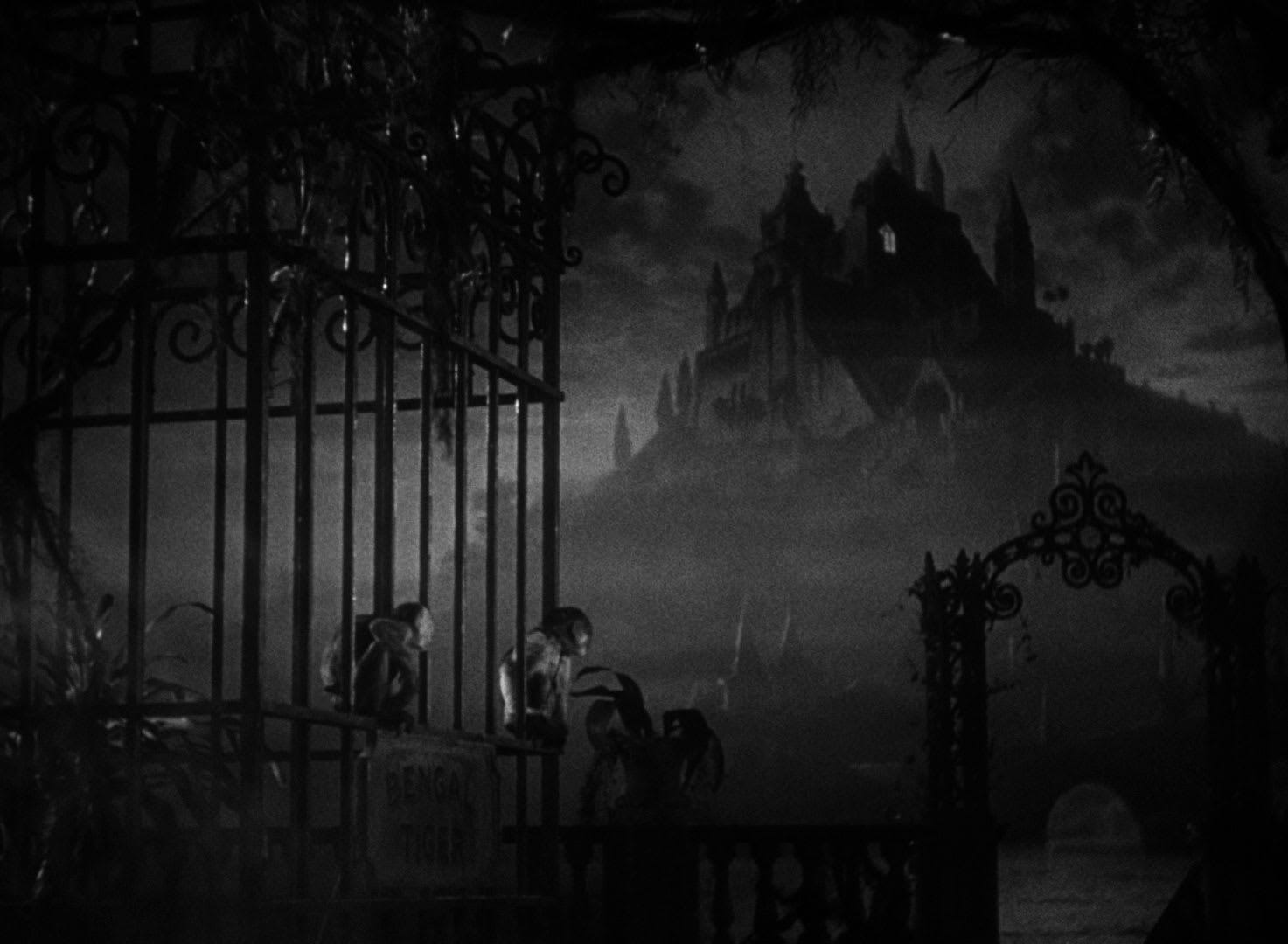
In 1845 Edgar Allan Poe became a household name overnight with the publication of his most famous poem, “The Raven.” His first poetry collection had been published anonymously in 1827, shortly after Poe moved to Boston at the age of 17, having accumulated large gambling debts in a failed effort to pay his outstanding tuition fees at the University of Virginia. The collection’s title poem, “Tamerlane,” is a fictional narrative that depicts a regretful tyrant Timur on his deathbed, reminiscing about the lost love of his youth, a romantic bliss sacrificed to his immense ambition. Though a juvenile attempt, Poe’s debut stylistically and thematically mirrors the work of Lord Byron (an early poetic influence), especially his Oriental romance The Giaour.11 Tamerlane and Other Poems was printed in a limited run of 50 copies with the anonymous attribution, “By a Bostonian.” By the time its authorship had been traced back to Poe, surviving copies were scarce. With just twelve copies extant, Tamerlane—referred to by collectors as the “Black Tulip”—is considered the rarest book in American literature.12 Tamerlane served as an alter ego for Poe, who struggled with perfectionism and literary ambition as well as troubled romantic interests. On May 11 and May 18, 1833 he published two poems in the weekly periodical the Baltimore Saturday Visiter; one is a lullaby addressed to an anonymous woman, while the other, “Fanny,” mourns the loss of young love. Both poems were signed, pseudonymously, “Tamerlane.” Four years after “The Raven” won him global fame, Poe died under mysterious circumstances at the age of 40, after being found outside a Baltimore tavern on election day in a state of delirium. In the absence of medical records, theories about the cause of death have included drug or alcohol overdose, tuberculosis, syphilis, cholera, rabies, influenza, poisoning, murder, and accidental manslaughter as a result of cooping.13
When I made my prodigal return to literary studies I began with the classics. Unsure how an English degree would provide future job opportunities or financial security, I abandoned practicality altogether and devoted myself to studying the Western canon. I joined a Great Books Club and enrolled in the Great Books Program at my community college, eventually receiving an award for my coursework, a certificate of achievement and the earnestly middlebrow title of “Great Books Scholar.” When I transferred to UCLA I continued this self-imposed program with an outmoded curricular tradition: I took Chaucer, Milton and Shakespeare—core courses that had once all been mandatory to complete the BA in English. One quarter I took an entire class on Henry James in a mood of contrarian obstinacy. “Sounds like a waste of time,” my then boyfriend teased when I shared my elective, to which I sniffed (precious me) that I didn’t think any book was a waste of time.14 If this all sounds rather decadent for a public school undergraduate, and on the heels of the Great Recession no less, I’m inclined to agree. But here’s the strangest part: I wasn’t there for personal advancement, or even literary study for its own sake. What I really wanted was to learn how to write well. (Naturally I distrusted the capacity of creative writing programs to teach me this.) My motive was faulty, and I followed it like primrose. I can’t say exactly when this fundamental error became clear to me—“Some people think this is some kind of art project,” one disgruntled professor scoffed to another student, as I passed within earshot on my way out of class—only that it did. I guess there are some things I still prefer to be wrong about.
The society, the civilization they were talking about, these theoreticians, was evidently theirs; they owned it, they liked it; they were human, fully human, bashing, sticking, thrusting, killing. Wanting to be human too, I sought for evidence that I was; but if that’s what it took, to make a weapon and kill with it, then evidently I was either extremely defective as a human being, or not human at all.
That’s right, they said. What you are is a woman. Possibly not human at all, certainly defective. Now be quiet while we go on telling the Story of the Ascent of Man the Hero.
—Ursula K. Le Guin, “The Carrier Bag Theory of Fiction”
If you enjoyed this post you might like...


readings
Charles Nicholl, The Reckoning: The Murder of Christopher Marlowe, University of Chicago Press, 1995
Park Honan, Christopher Marlowe: Poet & Spy, Oxford University Press, 2007
Christopher Marlowe, The Complete Plays, Penguin, 2004
The Cambridge Companion to English Renaissance Drama, ed. A. R. Braunmuller & Michael Hattaway, Cambridge University Press, 2003
Lord Byron, The Major Works, Oxford Classics, 2000
Peter Ackroyd, Poe: A Life Cut Short, Vintage, 2008
Ibn Khaldûn, The Muqaddimah: An Introduction to History, trans. Franz Rosenthal, Princeton University Press, 1989
“They err’d, as aged men will do; but by
And by we’ll talk of that; and if we don’t,
’T will be because our notion is not high
Of politicians and their double front,
Who live by lies, yet dare not boldly lie:
Now, what I love in women is, they won’t
Or can’t do otherwise than lie, but do it
So well, the very truth seems falsehood to it.

And, after all, what is a lie? ‘Tis but
The truth in masquerade; and I defy
Historians, heroes, lawyers, priests, to put
A fact without some leaven of a lie.”
—Lord Byron, Canto 11, Don JuanWilliam Shakespeare, Julius Caesar, Act 3, Scene 1.
For all Marlowe anecdotes and quotations see Charles Nicholl’s The Reckoning: The Murder of Christopher Marlowe.
A pivotal event in France’s religious wars in which a violent Catholic mob slaughtered thousands of Calvinist Protestants and many prominent aristocratic Huguenot leaders.
Generally acknowledged as the primary influence on Shakespeare’s Hamlet, with similar themes and structural devices such as the “Mousetrap” and vengeful ghost.
Rumors about Marlowe’s suspicious activities had boiled over in his final year, and his degree candidature was being contested on the grounds that he was a Catholic defector. The rumors were addressed in a letter to school authorities from the Privy Council, and Marlowe ultimately received his MA degree.
An early handgun, the caliver was a more portable, standardized version of the arquebus.
Conflicting accounts place the discovery on different dates and locations. See Park Honan’s Christopher Marlowe: Poet & Spy.
Usually written Quod me alit me extinguit, or “That which feeds me extinguishes me.” See Charles Nicholl’s introduction to The Reckoning: The Murder of Christopher Marlowe.
See Greer’s opinion in The Guardian, “Spare us more Shakespeare ‘portraits’—even then no one cared what the playwright looked like.”
Along with other epic narrative poems such as Child Harolde’s Pilgrimage and Don Juan, The Giaour is a key text in the development of the “Byronic hero”—a brooding, antiheroic figure that would loom prominently in 19th century literature, eventually finding its epitome in Victorian fiction with Emily Brontë’s Heathcliff in her 1847 novel Wuthering Heights.
One of two privately held copies sold at auction in 2024 for $420,000. A copy stolen from the McGregor Room vault in the Alderman Library at the University of Virginia in 1973 has never been recovered. See Bradford Morrow’s essay for Literary Hub, “In Search of the Rarest Book in American Literature: Edgar Allan Poe’s Tamerlane.”
Cooping was a form of election fraud in which victims were abducted by gangs, held captive, often drugged or beaten, dressed in disguise and forced to vote multiple times.
Have I ever truly believed this? I doubt it.
Viva the note, the footnote, the blurb, the punchline!
This is a great little piece and I appreciate the form of it very much.