
on myth
metaphor and meaning

Myth does not deny things, on the contrary, its function is to talk about them; simply, it purifies them, it makes them innocent, it gives them a natural and eternal justification, it gives them a clarity which is not that of an explanation but that of a statement of fact.
—Roland Barthes, Mythologies (trans. Annette Lavers)
For, as it is dislocation and detachment from the life of God, that makes things ugly, the poet, who re-attaches things to nature and the Whole,—reattaching even artificial things and violations of nature, to nature, by a deeper insight—disposes very easily of the most disagreeable facts.
—Ralph Waldo Emerson, “The Poet”
I should be careful not to let the allure of notes carry me away from my original pursuit. It’s easy to be drawn in, enchanted by the promise of a panacea discovered through deep study and experimentation. If I’m abducting images and themes, appropriating passages and displacing them to foreign contexts, I tell myself, it’s all in the service of a higher purpose. There is at least one problem though: in the distillation of essential ideas from the mash of reading material, there is a tendency to reduce, to compartmentalize and purify, to render antiseptic and foreclose potential proliferations of meaning. When what I want is just the opposite: to generate alternate meanings and alchemize, from already existent concepts, new or unrealized value. Do I defeat myself in this, and only tighten a self-made Gordian knot? How can I discover new territory by charting old ground? Poets can, of course, working as they do with a set of predetermined values that they shuffle and deal out to produce an infinite number of hands that can enrich players—and impoverish, depending on skill or chance or the parameters of the game. Poetic metaphor is the basis not only of linguistic meaning,—“Every word was once a poem,” says Emerson. “Every new relation is a new word.”—but also of cognition and, by extension, reality itself.1 If figurative language confers a Midas touch, what might figurative citation do? And then, is it really desirable to transmute old meanings into new ones, when I could just as well leave things as they are, as they should be. Because, in mining texts for their sense, I inevitably miss that treasure of a whole picture. Extracting precious gems from their native settings to display them in a case with all the others, am I not defiling some natural order for personal gain? In which case I’ve performed a subtractive, rather than additive, operation, with a lesser sum. How else to account for my manner of making sense from reference, but to reckon that what I’m mainly inventing is a personal mythology. Through note taking, I’ve passed, as Roland Barthes would say, “from the state of reader to that of mythologist.”2
Our entire language is made up of short little dreams; and the delightful thing about it is that we sometimes fashion from them thoughts that are strangely exact and wonderfully reasonable.
Indeed there are so many myths in us, and such commonplace ones, that it is almost impossible to segregate completely in our minds anything that is not a myth. One cannot even talk about it without creating a myth, and am I not at the moment making a myth of the myth in order to satisfy the whim of a myth?
Yes, dear friends, I do not know what to do in order to escape from what does not exist!
—Paul Valéry, “On Myths and Mythology,” Selected Writings (trans. Anthony Bower)
The meaning will be for the form like an instantaneous reserve of history, a tamed richness, which it is possible to call and dismiss in a sort of rapid alternation: the form must constantly be able to be rooted again in the meaning and to get there what nature it needs for its nutriment; above all, it must be able to hide there. It is this constant game of hide-and-seek between the meaning and the form which defines myth.
—Roland Barthes, Mythologies (trans. Annette Lavers)
Cybele, or the Great Mother of the Gods, was an ancient Phrygian deity whose devout cults spread from the slopes of Dindymon into Greek and Roman territories, where they soon became infamous for ecstatic, orgiastic rites that were eventually banned in Rome.3 Cybele was believed to be the mother of gods, humans and animals and was typically depicted flanked by lions and seated on a throne or in a chariot. Her followers, who referred to their goddess as the Mountain Mother, performed frenzied ceremonies of worship led by priests who submitted themselves to self-castration on entering her service. Annual festivals lasting twelve days took place in the second half of March. A ceremonial pine tree was felled and erected at her shrine, adorned with violets said to have sprung from the blood of her lover Attis, a Phrygian fertility god who, according to legend, castrated himself at the base of a pine tree, where he bled to death.4
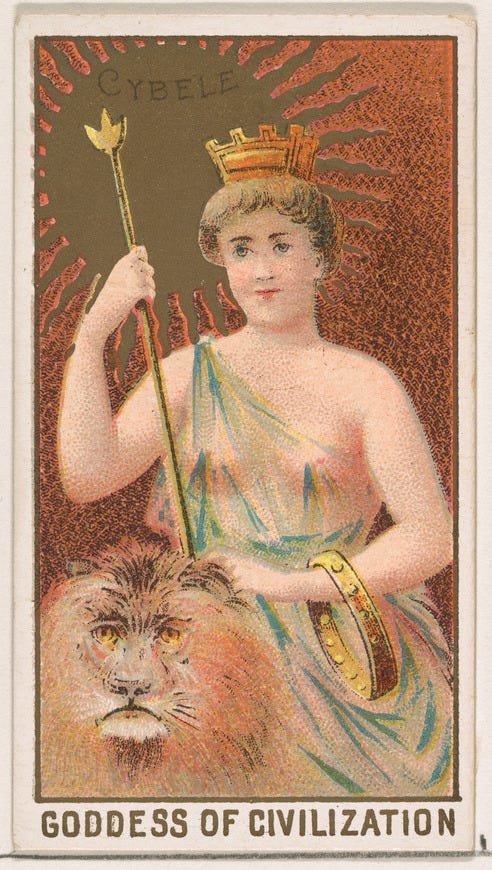
The tenth day of the festival was the designated “Day of Blood,” when an archpriest made a ritual offering of blood freshly drained from his own arm to the goddess, while lesser clergy danced to the rhapsodic music of cymbals, drums and flutes, slashing their arms and splattering blood on the sacred pine tree and altar. On the final day of the festival a silver statue of Cybele was carried in solemn procession to a tributary of the Tiber River to be bathed, a sacred stone—the special symbol of the goddess said to have fallen from heaven—set in the statue’s forehead.
Contrary to the ancient myth, wisdom does not burst forth fully developed like Athena out of Zeus’s head; it is built up, small step by small step, from most irrational beginnings.
—Bruno Bettelheim, The Uses of Enchantment: The Meaning and Importance of Fairy Tales
The Great Mother figure would remind the Greeks of their own goddess Rhea, with whom Cybele would gradually become conflated in Greek mythology. As the Roman Republic became more established, and later as the Roman Empire grew more and more expansive, the “Mater Deum Magna Idaea” (her Latin epithet, meaning “Great Idaean Mother of the Gods”) became identified with, and dissipated through, a clutch of familiar deities including Maia, Ops, Tellus, and Ceres.5 The Phrygian goddess’s Oriental origins were thus subdued, and Cybele became fully assimilated into Western European culture.
The figure of the tyrant-monster is known to the mythologies, folk traditions, legends, and even nightmares of the world; and his characteristics are everywhere essentially the same. He is the hoarder of the general benefit. He is the monster avid for the greedy rights of “my and mine.” The havoc wrought by him is described in mythology and fairy tale as being universal throughout his domain. This may be no more than his household, his own tortured psyche, or the lives that he blights with the touch of his friendship and assistance; or it may amount to the extent of his civilization. The inflated ego of the tyrant is a curse to himself and his world—no matter how his affairs may seem to prosper. Self-terrorized, fear-haunted, alert at every hand to meet and battle back the anticipated aggressions of his environment, which are primarily the reflections of the uncontrollable impulses to acquisition within himself, the giant of self-achieved independence is the world’s messenger of disaster, even though, in his mind, he may entertain himself with humane intentions. Wherever he sets his hand there is a cry (if not from the housetops, then—more miserably—within every heart): a cry for the redeeming hero, the carrier of the shining blade, whose blow, whose touch, whose existence, will liberate the land.
—Joseph Campbell, The Hero with a Thousand Faces
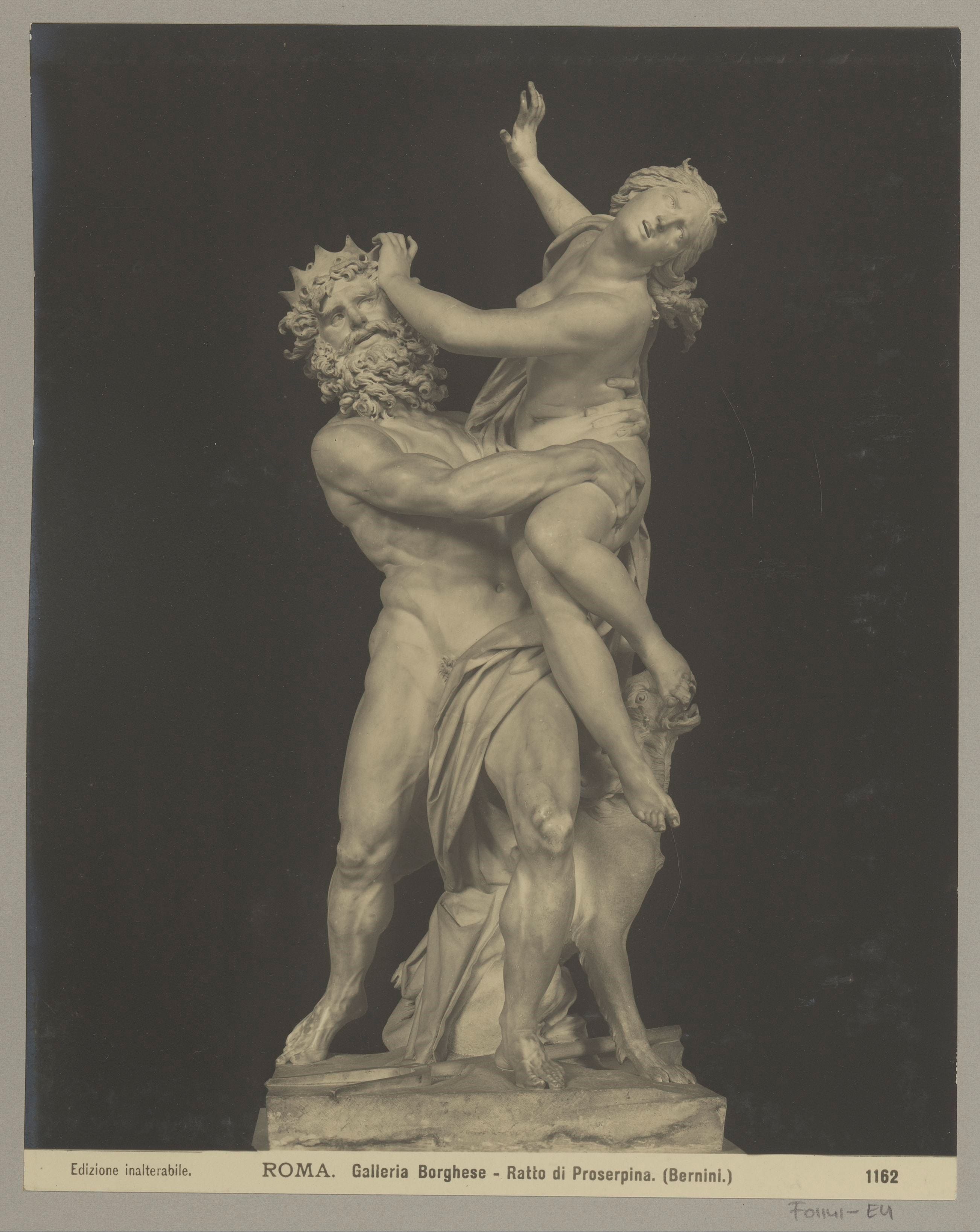
The tale of Hades’s abduction of Persephone to the underworld to be his captive bride is well known. Less told are ancient matriarchal myths, with nonviolent depictions of voluntary descents into shadow realms characterized as divine, feminine rites of passage. “Both the classical Persephone myth and the core of the fairy tale ‘The Handless Maiden,’” writes Jungian psychoanalyst and scholar Clarissa Pinkola Estés, “are fragmentary dramas which derive from the more cohesive ones portrayed in the older religions. What was once a longing to find the underworld Beloved became, somewhere in time, a lust and seizure in later myths.”6 According to a text dating from the end of the third millennium BCE, the goddess Inanna (worshipped in Sumer as Ishtar) demands admittance to Kur, the ancient Mesopotamian underworld over which her sister Ereshkigal rules, in order to attend funeral rites for her dead brother in law.7 She is allowed to pass through the netherworld’s seven gates by removing an article of her dress at each barrier, until she arrives, naked, in front of her sister. Along with her regalia, the goddess is stripped of her supernatural powers and left at the mercy of the Anunnaki—the seven judges of the dead who ultimately rule against her and transform her into a corpse. After three days and nights, Inanna is resurrected with the help of her servant who, following instructions left in case she didn’t return, enlists the assistance of Enki, the god of wisdom and magic.
We find here again the figure of the scales: reality is first reduced to analogues; then it is weighed; finally, equality having been ascertained, it is got rid of. Here also there is magical behavior: both parties are dismissed because it is embarrassing to choose between them; one flees from an intolerable reality, reducing it to two opposites which balance each other only inasmuch as they are purely formal, relieved of all their specific weight.
—Roland Barthes, Mythologies (trans. Annette Lavers)
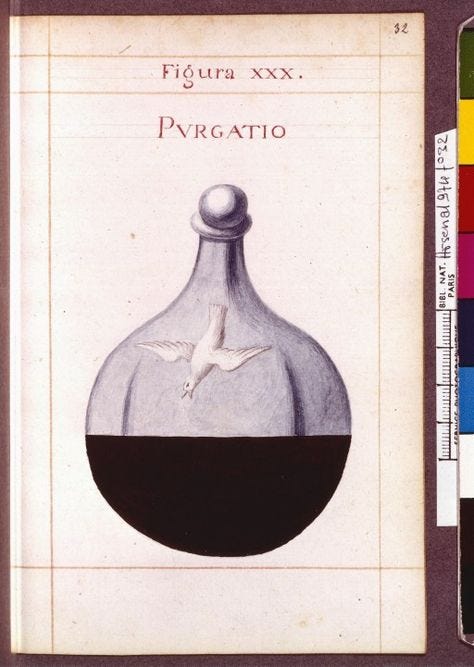
The goddess of war, fertility, and the sky, Inanna’s common title was Queen of Heaven, and her emblems were the lion, the dove, the eight pointed star of Ishtar, and the hook shaped knot of reeds. Her main consort was Tammuz, a fertility god associated with agriculture and shepherding. On her return from the underworld, Inanna faulted her lover for insufficiently mourning her death, and banished him to Kur as punishment. She eventually relented, and allowed her disfavored lover to split the sentence with his sister, who took his place in the underworld for half the year so he could return to the land of living, and bring with him spring thaw and vegetation. Later Greek myths would retain this seasonal resolution; however the haughty, powerful female figure of Inanna would metamorphose into the more passive, victimized, and Hellenic Persephone.
It is characteristic of our time that the archetype, in contrast to its previous manifestations, should now take the form of an object, a technological construction, in order to avoid the odiousness of mythological personification. Anything that looks technological goes down without difficulty with modern man.
—Carl Jung, “Flying Saucers: A Modern Myth” (trans. Richard & Clara Winston)
The taxonomic bird genus that comprises the pigeon and dove species, Columba, is Latin for “dove,” and derives from the Greek kolumbos, meaning “diver.”
Before its introduction to the New World, the now ubiquitous (in both animal and symbolic form) dove could only be found on its native continents of Africa, Asia and Europe.
The English bird name “dove,” a heteronym of the past tense form of “dive,” originates in the Proto-Germanic dubo—a root form with dubious etymology, but presumed to be primarily imitative of the bird’s familiar cooing.
Also dubious is the etymology of the Ancient Greek peristera, another term for dove that has been traced back to a Semitic phrase meaning “bird of Ishtar.”
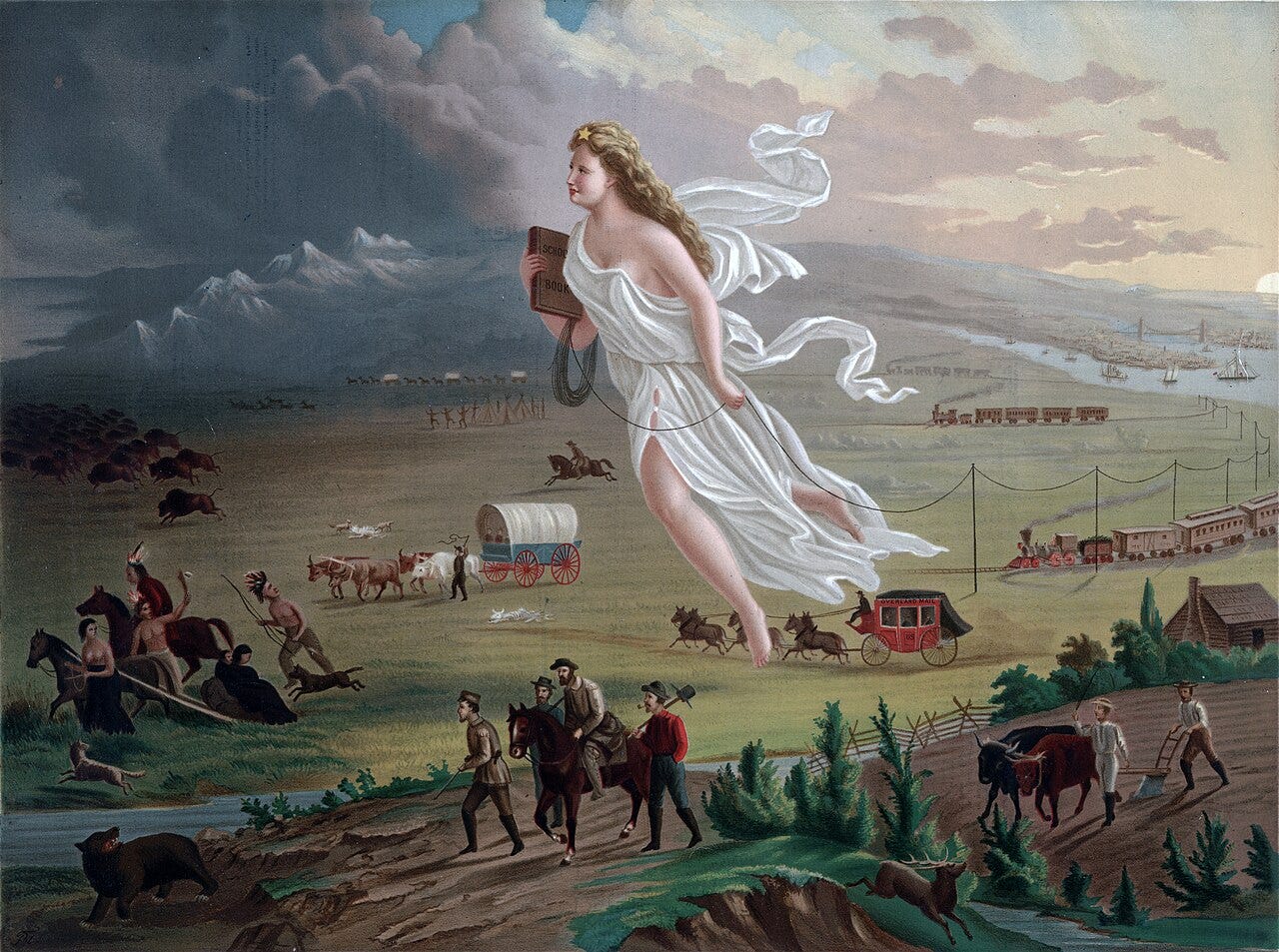
“Columbia” is a neo-Latin toponym formed in the 18th century, from the surname of Christopher Columbus, as a feminine personification of the United States.
Popular early depictions of Columbia dressed her in an American flag and Phrygian cap; also known as a “liberty cap,” it was commonly associated with classical antiquity and civilizations in Anatolia, Asia and Eastern Europe.
Sayings, sentences, what of them?
Flashes, lullabies, are they worth remembering?
On the babbling tongues of the people have these been kept.
In the basic mulch of human culture are these grown.
Along with myths of rainbow gold where you shovel all you want and take it away,
Along with hopes of a promised land, a homestead farm, and a stake in the country,
Along with prayers for a steady job, a chicken in the pot and two cars in the garage, the life insurance paid, and a home your own.
—Carl Sandburg, The People, Yes
If you enjoyed this post you might like...


readings
Roland Barthes, Mythologies, trans. Annette Lavers, Hill and Wang, 1972
Bruno Bettelheim, The Uses of Enchantment: The Meaning and Importance of Fairy Tales, Vintage, 2010
Joseph Campbell, The Hero with a Thousand Faces, New World Library, 2008
Jung on Mythology, ed. Robert A. Segal, Princeton University Press, 1998
George Lakoff and Mark Johnshon, Metaphors We Live By, University of Chicago Press, 2003
Clarissa Pinkola Estés, Women Who Run with the Wolves: Myths and Stories of the Wild Woman Archetype, Ballantine Books, 1995
Paul Valéry, Selected Writings, trans. Anthony Bowers, et al., New Directions, 1964
“What is real for an individual as a member of a culture is a product both of his social reality and of the way in which that shapes his experience of the physical world. Since much of our social reality is understood in metaphorical terms, and since our conception of the physical world is partly metaphorical, metaphor plays a very significant role in determining what is real for us.” See George Lakoff and Mark Johnson’s Metaphors We Live By.
See also Ralph Waldo Emerson’s 1844 transcendentalist essay “The Poet” in Essays: Second Series.
See the concluding essay “Myth Today” in Roland Barthes’s Mythologies.
Dindymon is a mountain in Anatolia (modern day Turkey). For mythological texts consulted see Women Who Run with the Wolves: Myths and Stories of the Wild Woman Archetype by Clarissa Pinkola Estés and the Encyclopedia Britannica.
In Ovid’s Metamorphoses, following his self-mutilation, Attis transforms into a pine tree, a resurrection symbolizing the return of vegetation in spring.
The modifier “Idaean” relocates the Cybele’s center of worship from the Anatolian Dindymon to Mt. Ida in Crete—a summit associated with the goddess Rhea.
See Women Who Run with the Wolves: Myths and Stories of the Wild Woman Archetype by Clarissa Pinkola Estés.
Kur is short for Kur-nu-gi-a, or “the land of no return.”
Conflicting motivations exist in divergent versions of the myth, with some attributing her descent to the desire to usurp her sister and become Queen of the Underworld.
Inanna and Ishtar are believed to have been separate deities at one point, before becoming conflated into one figure.